



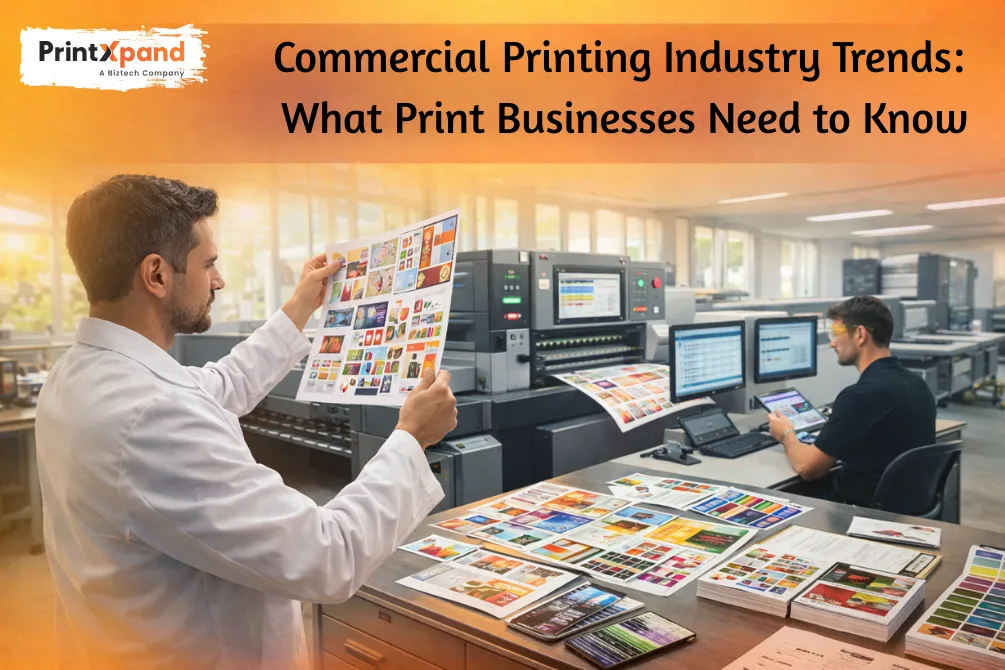
Survival in the printing world now requires dodging technological disruptions more often than a press operator avoids a paper cut. The global commercial printing market is valued at US$837.20 billion in 2025 and is forecast to grow toward US $940.54 billion by 2030 (source).
This growth underscores that keeping up with Commercial Printing Industry trends is no longer a sci-fi fever dream. Instead, it has become a relentless foreman demanding leaner, meaner automation to keep margins from flatlining. Customers are ditching generic bulk for personalization that makes a tailored suit look like a potato sack. If the production line still lacks a soul and a chip, it is essentially a museum exhibit with a high utility bill.
Shifting demands have turned loyalty into a ghost while sustainability has evolved from a polite suggestion into a legal chokehold. Adapting is not about keeping pace but about sprinting while everyone else is still debating the cost of ink. Ignoring these seismic shifts is the fastest way to turn a thriving shop into a historical footnote.
Trend 1: Rise of Automation and Smart Print Workflows
Hiring humans to manually check files in prepress is now as efficient as using a sundial to track a space race. The smart money is on print automation that treats prepress like a high-speed car wash where errors are scrubbed before they even hit the metal.
Scheduling and job routing have evolved from chaotic whiteboards to digital masterminds that play 4D chess with machine capacity. If the current MIS and W2P setup do not talk to each other, the business is basically running a relay race with a lead pipe instead of a baton.
Integrating these systems creates a central nervous system that manages everything from the first click to the final delivery without a single panic attack. AI-based quality checks are the new sheriffs in town, catching microscopic flaws that a tired operator would miss after their third coffee.
This shift is not a luxury but a survival kit for anyone tired of burning cash on reprints and manual labor. Embracing a seamless workflow ensures the only thing gathering dust in the shop is the old “How-To” manual for analog presses.
Trend 2: Growing Adoption of Web-to-Print & Online Ordering
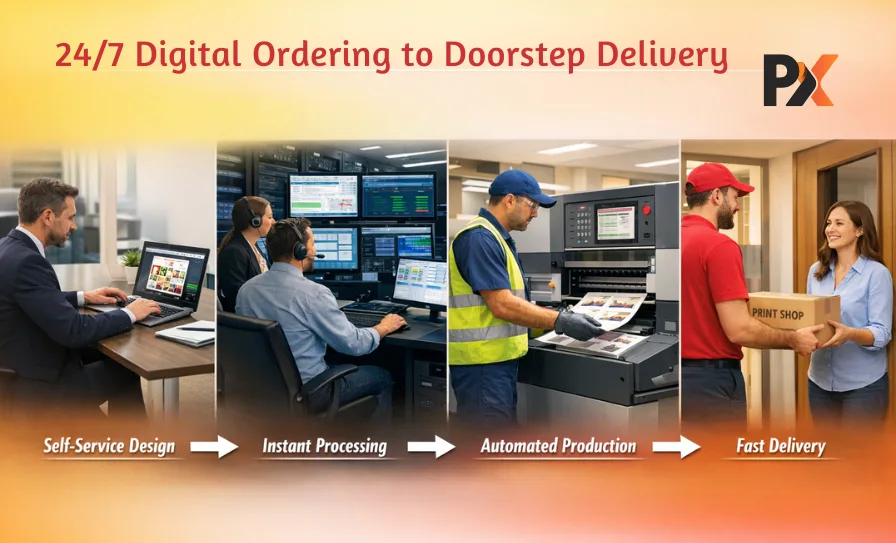
Customer service departments that still rely on endless phone tag and email chains are essentially running a museum of inefficiency. Self-service portals have turned the ordering process into a 24/7 digital buffet where clients serve themselves while the shop sleeps.
Template-based ordering keeps brand guidelines on a shorter leash than a disobedient puppy, stopping users from turning professional logos into Comic Sans nightmares. Waiting for a human to approve a quote is like waiting for a solar eclipse; it is beautiful when it happens but takes far too long. Modern web-to-print systems handle the heavy lifting, crushing job cycles from days into minutes. This setup does not just save time; it prevents the slow death of margins caused by manual data entry and “fat-finger” errors.
If the business is not open for orders at 2 AM, it is basically handing cash to the competitor across the street. Faster cycles and digital handshakes are no longer optional extras; they are the lifeblood of a shop that actually wants to grow.
Trend 3: Increased Demand for Short-Run & On-Demand Printing
Stockpiling thousands of generic brochures is now the business equivalent of buying a pager in the smartphone era. One of the most prominent Commercial Printing Industry Trends is the shift from massive, dusty warehouses of bulk print to sleek, on-demand batches that actually mirror what people want to buy.
Ecommerce has trained customers to expect speed and surgical precision, turning the old “minimum order quantity” into a relic that belongs in a museum. Marketing strategies now pivot faster than a toddler on a sugar rush, making short-run printing the only way to stay relevant without drowning in obsolete inventory. Digital presses have made it possible to treat every print job like a unique masterpiece rather than a repetitive chore. This on-demand model is a financial life jacket, preventing capital from being tied up in mountains of paper that will likely end up in a shredder by next quarter.
If the shop is still pushing “cheaper by the thousand” while the world wants “perfect by the ten,” it is essentially selling buggy whips to Tesla owners. Speed and personalization are the new currency, and short-run capability is the vault.
Trend 4: Personalization & Variable Data Printing (VDP)
Sending a generic “Current Resident” postcard is the marketing equivalent of screaming into a void while wearing a bag over your head. Hyper-personalization has turned Variable Data Printing into a precision tool that makes every piece of mail feel like a handwritten secret.
Direct mail is experiencing a bizarrely successful second act because people actually enjoy touching something that doesn’t require a password. Integrating print with marketing automation ensures that physical mail hits the doorstep exactly when a digital lead goes cold. This data-driven approach stops the bleeding of marketing budgets on spray-and-pray tactics that usually end up as birdcage liners.
Modern print shops must handle complex data sets with more care than a bomb squad to keep these campaigns running smoothly. If the technology cannot swap a name, an image, and a localized offer in one pass, it is basically a glorified photocopier. Using VDP means the business is no longer just selling ink on paper but is providing a direct line to a customer’s wallet. Sticking to static content is a one-way ticket to the recycling bin of history.
Trend 5: Sustainability Becoming a Competitive Differentiator
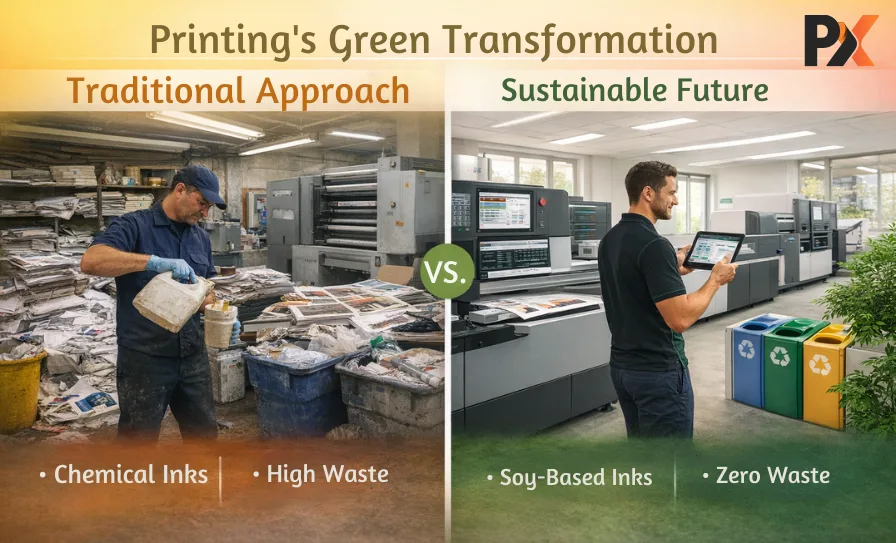
Treating environmental responsibility as a mere suggestion is a fantastic way to ensure the business becomes as extinct as the trees it claims to save. Sustainability has graduated from a PR stunt to a brutal competitive differentiator that separates the industry leaders from the dinosaurs.
Clients now demand recycled materials with the same intensity they once reserved for low prices. Switching to soy-based inks is not just about being “green”; it is about dodging the toxic fumes and volatile organic compounds that make traditional pressrooms smell like a chemical spill.
Energy-efficient equipment is the only thing standing between a healthy profit and a utility bill that looks like a phone number. Waste reduction via automation has turned the “oops, reprint it” culture into a relic of the past, saving both the planet and the payroll.
If the facility is not currently obsessed with energy consumption and circular processes, it is essentially burning cash to heat the parking lot. Sustainable practices are the new gold standard for reliability and forward-thinking operations.
Trend 6: Wide-Format Printing Growth (Signage, Packaging, Displays
Sticking exclusively to small-scale prints is a fantastic way to ensure the business remains as invisible as a stealth bomber. Wide-format printing has exploded because brands are tired of being ignored in a world of digital noise.
Retail signage and event banners have become the loud, colorful megaphones that actually stop people in their tracks. Staying informed on Commercial Printing Industry Trends helps businesses realize that if they cannot handle packaging prototypes or massive displays, they are essentially bringing a knife to a gunfight.
Digital wide-format tech is booming because it allows for high-impact graphics without the soul-crushing setup times of the past. It turns blank walls and empty floors into prime real estate for marketing messages that cannot be swiped away or blocked. This growth is a lifeline for shops looking to diversify before their traditional revenue streams dry up completely.
Embracing the “go big or go home” philosophy is the only way to stay relevant when everyone else is playing small.
Trend 7: Expansion of Packaging & Label Printing
Treating packaging as just a cardboard box is a fast track to becoming as forgettable as a dial-up ringtone. The ecommerce explosion has birthed a swarm of micro-brands that demand high-end, custom packaging without the traditional soul-crushing minimum order quantities.
Identifying the right commercial printing trends early on allows shops to realize that if they cannot handle private labels or rapid prototyping, they are essentially handing over a gold mine to the more agile guy down the street.
Digital packaging systems are the new industry heavyweights, allowing for surgical precision in branding without the ancient setup delays of analogue presses. This shift turns a simple shipping container into a social media worthy unboxing experience that keeps customers coming back like clockwork.
Relying on generic, oversized boxes is not just lazy; it is a direct assault on the profit margins and the brand reputation. Embracing the digital packaging boom ensures the business remains a vital partner rather than a disposable vendor.
Trend 8: Integration of MIS and Workflow Software for Efficiency
Running a print shop with disconnected MIS and Web-to-Print systems is like trying to drive a car where the steering wheel and the tires are in different time zones. The integration of these two heavyweights creates a unified digital brain that handles estimation with more precision than a diamond cutter.
Implementing true workflow automation in printing ensures manual job costing becomes a bad memory, as the system tracks every drop of ink and every second of labor in real time. Scheduling transitions from a frantic game of Tetris to a streamlined flow that maximizes machine uptime without a single human intervention. This synergy slashes turnaround times, ensuring that “rush job” no longer triggers a collective office breakdown.
Detailed reporting provides the cold, hard truth about profitability, exposing which clients are assets and which are just expensive hobbies. Relying on paper trails and verbal updates is a slow-motion collision with a brick wall. Efficiency is the only way to keep the lights on when the competition is moving at the speed of light.
Trend 9: Hybrid Printing Environments (Offset + Digital)
Choosing between offset and digital is no longer a civil war but a strategic marriage of convenience. Running a shop with only one technology is like trying to eat soup with a fork. Offset remains the heavy hitter for massive runs where the cost per unit actually makes sense.
Digital is the nimble cousin that handles hyper-customized batches without throwing a tantrum over setup times. Keeping an eye on current digital printing trends reveals that combining both allows for a “best of both worlds” approach that keeps the pressroom humming and the bank account from bleeding out.
This hybrid setup ensures that no job is too small to be profitable or too large to be manageable. Relying on ancient equipment for modern demands is a recipe for a very expensive disaster. Smart operators use this duo to hedge their bets against a volatile market. It is about having the right tool for the job instead of forcing a square peg into a round hole.
Trend 10: AI’s Impact on the Commercial Print Sector
a digital foreman that never sleeps or asks for a raise. Integrating it into proofing means catching “their” versus “there” before it becomes a five-figure reprint disaster. Error prediction acts like a crystal ball, flagging machine tantrums before the press actually grinds to a halt.
Quoting has shifted from a guessing game to a surgical strike, delivering pinpoint accuracy in seconds rather than days. Production planning and color correction are now handled by algorithms that have a better eye for detail than a caffeinated hawk. This tech allows for proactive maintenance, ensuring the only thing “down” in the shop is the price of waste.
Relying on manual checks in an automated world is like using a carrier pigeon to send an instant message. AI doesn’t just assist; it dominates the menial to let the shop focus on the monumental, effectively defining the print industry future for forward-thinking organizations.
What These Trends Mean for Print Businesses?
Embracing these seismic shifts is the difference between being a market leader and a cautionary tale whispered at bankruptcy hearings. Integrating smart automation and AI isn’t just about showing off; it’s a cold, calculated move to slash production costs and stop the hemorrhaging of revenue caused by manual incompetence. When the workflow is a seamless, digital masterpiece, the overhead drops faster than a lead weight in a vacuum.
Adopting sustainability and hyper-personalization—key pillars of current Commercial Printing Industry Trends—turns the business into a client magnet, attracting high-value partners who are tired of generic, eco-toxic relics. This strategic evolution ensures the shop is firing on all cylinders, delivering surgical precision that keeps competitors looking like they are stuck in the Bronze Age.
Reducing waste and shortening job cycles means the bank account finally gets a breather from the constant assault of inefficiency. Clients don’t just want a printer; they want a tech-forward ally that doesn’t treat the planet like a trash can. Failing to adapt is essentially a slow-motion dive into a paper shredder.
Conclusion
Clinging to outdated print methods is a one-way ticket to a museum basement. The industry is moving at breakneck speed, while laggards are still checking for paper jams in machines from the previous century. Monitoring Commercial Printing Industry Trends and adopting automation and AI is not a suggestion but a mandatory shield against financial ruin.
These trends are the difference between a thriving shop and one that is just waiting for the lights to go out. High-value clients have no patience for slow turnarounds or eco-toxic practices that belong in the dark ages. The writing is on the wall, and it was likely printed with a high-speed digital inkjet.
Smart businesses will grab the bull by the horns and transform their workflows before the market leaves them in the dust. Every second spent hesitating is a gift to a more agile competitor. Evolution is painful, but extinction is permanent. It is time to step up or step aside.