



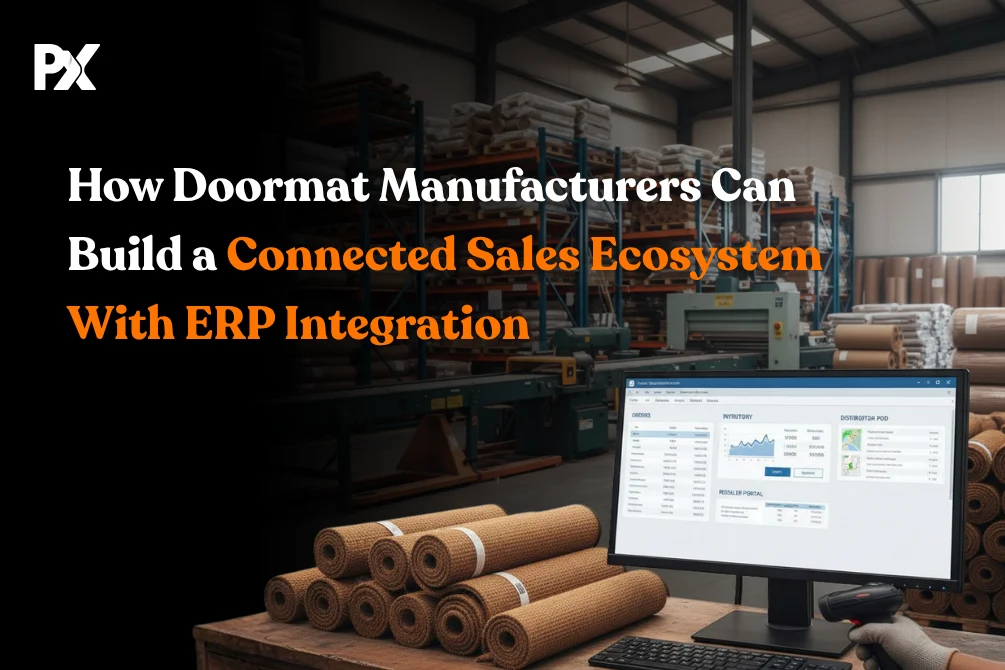
Doormat manufacturers reach a point where the challenge is no longer production-it’s coordination. When orders flow in from B2C shoppers, resellers, distributors, sales reps, and even internal teams, the business starts feeling the strain long before production does. Most manufacturers rely on their ERP to manage inventory, pricing, and order flow, but trouble begins when multiple user groups rely on email and manual steps to push orders into the system.
That’s where things get slow. Customer service teams end up spending their days entering orders instead of helping customers. Sales reps chase updates through email threads. Resellers wait for pricing confirmations. Distributors struggle to get visibility. And while none of this stops the business from growing, it definitely slows it down.
Many manufacturers now want something more practical: a way to centralize all sales channels without exposing their ERP or overloading the internal team. They want sales reps, resellers, distributors, B2C buyers, and customer service members to have their own dedicated space to work—while everything quietly syncs to the ERP in the background.
This is exactly where a connected, multi-platform setup can transform operations. It gives every user type the right tools, reduces manual entry, and ensures all orders land in the ERP accurately. Even better, it’s far simpler to implement than most manufacturers expect.
Let’s break it down step by step.
Why Doormat Manufacturers Can Benefit From a Structured ERP-Connected Workflow
When a manufacturer already has its own production and printing facility, the ERP naturally becomes the central source of truth. But as the business expands and new sales channels emerge, the ERP alone can’t support the workload—not because it lacks features, but because it’s not designed to be accessed by dozens of external users.
Manufacturers need something built around the ERP, not in place of it. And that need usually revolves around a few core requirements.
First, manufacturers want structured control over every sales channel. Sales reps need a space where they can manage multiple accounts. Resellers want to access their negotiated pricing without relying on email. Distributors often look for print-on-demand solutions for doormats to make ordering faster. And B2C customers expect a clean shopping experience through an e-commerce platform for doormat sales.
Second, these businesses want a system that respects pricing rules. Each user group requires different pricing tiers, and manual calculations often lead to delays or mistakes. A connected system makes this easier by automating the logic behind those rules.
Third, they need a platform that keeps the ERP protected. External users can’t be given login access, so the sales ecosystem must offer the functionality they need without exposing internal workflows.
And finally, manufacturers want everything to remain centralized. Inventory data, order details, customer records, and tracking updates must move directly between the portals and the ERP. This is where reliable ERP integration for manufacturing businesses becomes essential. A role-based workflow reduces manual load while keeping the ERP for doormat manufacturers at the center of pricing, inventory, and production updates.
In short, manufacturers need a system that simplifies every sales workflow, not for one user group but for all of them.
Want this system to work for your business?
Why Traditional Order Handling Can Hold Doormat Businesses Back
Most manufacturers don’t rethink their operational setup until they see how much time their team spends doing things manually. Orders come in through emails. Sales reps send screenshots. Distributors forward old purchase orders. Resellers copy data from spreadsheets. And the customer service team must make sense of everything before it reaches the ERP.
This process slows businesses down more than they realize.
When customer service staff spend half their day copying order details from emails into the ERP, it’s only a matter of time before something gets missed. Maybe a wrong variant gets selected, or an old price gets carried forward—small things, but they turn into bigger headaches later.
Most manufacturers also juggle several pricing layers—retail rates, bulk discounts, reseller pricing, distributor agreements, and whatever special deals sales reps negotiate. Trying to track all of this manually is tiring for the team and invites unnecessary mistakes. Much of this friction disappears when the ERP integration standardizes how orders flow into the system.
Another problem is visibility. Sales reps want to track orders, but they rely on customer service for updates. Resellers want inventory insights but don’t have access to them. Distributors want clear timelines but often get partial answers. None of this is efficient.
The biggest limitation, however, is scalability. As order volume increases, adding more emails, spreadsheets, and manual steps becomes unsustainable. Manufacturers want to scale, but they quickly realize their internal team can’t keep up without a better operational foundation.
This often leads to questions like:
“Can we fix this without replacing the ERP?”
“Is it possible to automate pricing for different user types?”
“Can resellers and distributors place orders without going through our team?”
The answer to all of these is yes—when the right system is implemented around the ERP.
| Expert Tip: Before introducing automation, clean up your existing pricing tiers. A clear pricing structure makes your ERP for doormat manufacturers far more reliable when integrated with external portals. |
How Building a Multi-Portal Ecosystem Can Connect All Sales Channels
A structured, multi-portal ecosystem gives doormat manufacturers exactly what they need: a centralized way to manage all sales channels without forcing every user into the same space.
The nice part is that manufacturers don’t have to flip a switch overnight. This setup can be rolled out section by section, allowing every user group to adjust without disrupting daily work.
This kind of system usually comes together through a handful of building blocks that work well side by side.
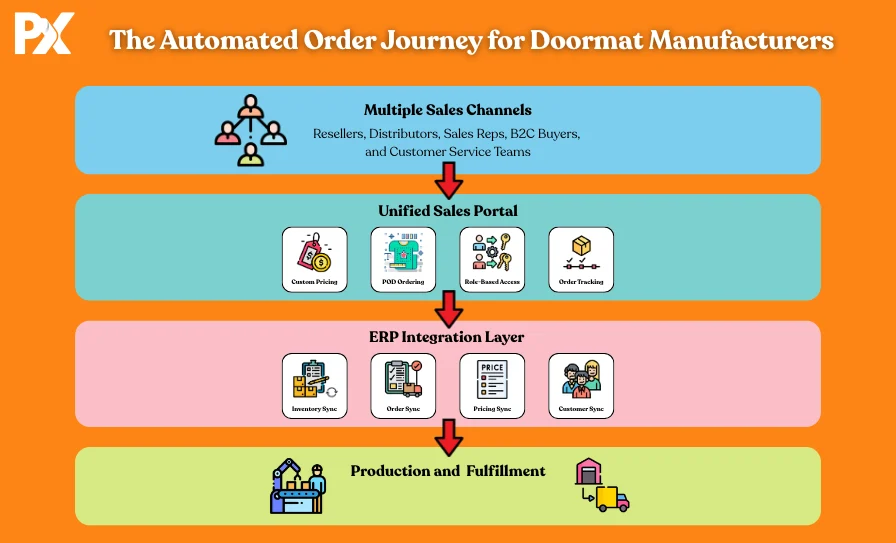
1. Role-Based Portals for Resellers, Sales Reps, and Customer Service Teams
Each user gets a space designed for the way they actually work. Sales reps can place orders for their clients just as easily as they reorder popular items. Resellers can check their pricing and submit bulk orders without waiting for someone inside the company. The customer service team gets tools to handle special cases instead of retyping order details all day.
Because each portal is role-based, users only see the features, pricing, and data relevant to them.
2. A Complete E-Commerce Platform for B2C Buyers
Retail shoppers want something easy-browse, pick a doormat, pay, and track it. A dedicated e-commerce platform for doormat sales keeps the process simple and keeps everything in sync with the ERP, so stock levels and order updates are always accurate.
3. Print-On-Demand System for Distributors
Distributors work differently. They reorder certain SKUs often and need quick access to current stock and production timelines. A print-on-demand style portal lets them place these orders whenever they need, without looping in internal teams each time. This structure, in short, supports print-on-demand solutions for doormats that help distributors reorder popular SKUs without waiting for manual confirmations.
4. Centralized Admin Panel for Internal Controls
From here, the business sees the whole picture. Admins can tweak pricing, edit catalogs, adjust access, or check what’s happening across the entire system—all from one dashboard.
5. Deep Integration Layer Connected to the ERP
This is the part that holds everything together. Orders, customer details, pricing, and stock levels flow back and forth with the ERP automatically, removing all the manual steps that used to slow things down.
At this point, manufacturers usually ask: “How long does it take for teams to adopt this system?” Adoption becomes surprisingly quick because each user only interacts with features relevant to their role. There’s no overwhelming interface or unnecessary complexity.
With complete doormat production web to print ERP integration, details like print specs, variants, and order quantities sync automatically, eliminating manual re-entry entirely.
Where Doormat Manufacturers Can See Immediate Improvements After Integration
Once this setup goes live, the shift is noticeable. Customer service finally gets breathing room. Sales reps move faster. Resellers and distributors feel more independent because they don’t have to email for every small thing. And B2C customers enjoy a cleaner journey end to end. The e-commerce platform for doormat sales plays a key role here by giving shoppers real-time visibility into stock and order updates
Operationally, everything becomes cleaner. Orders follow the same structure, so the ERP receives data in a consistent format. When everything feeds back into a unified ERP for doormat manufacturers, data accuracy increases, and teams trust the system more. Pricing errors drop significantly because the system automates tiered pricing. Sales updates become instantly accessible, which gives teams better planning abilities. And all user activity remains traceable in one place.
From a customer perspective, the experience improves because clarity replaces guesswork. Users see their order status, inventory information, and pricing without sending emails or waiting for responses.
Manufacturers also wonder how this setup handles long-term scale. The truth is, once the base system is live, adding new product lines, price groups, or sales channels becomes far easier than before.
Another question that comes up frequently is about long-term scalability. Once the system is in place, adding new products, new pricing tiers, or new sales channels becomes much easier. The foundation is already built for expansion.
| Expert Tip: When rolling out to distributors and resellers, provide short onboarding videos. A quick walkthrough helps users adopt the new system without extra training sessions and reduces support load during the initial phase. |
A Future-Ready Setup That Supports Every Sales Channel
The real strength of this approach shows over time. Bringing in new resellers becomes smoother, and adding new product categories doesn’t disturb the existing setup. Teams stay organized even as the business expands.
This framework also makes automation easier. For example, businesses can automate order confirmations, shipment notifications, low-stock alerts, and pending approval messages. All of it fits naturally into the connected environment.
And because the ERP remains the engine behind it all, the business doesn’t lose control—it gains predictability and structure.
Your Next Step Toward a More Connected and Scalable Doormat Business
A connected, role-based platform integrated with your ERP does exactly that.
It simplifies daily operations, increases transparency, and gives your team the freedom to focus on growth rather than manual tasks. Even better, it fits naturally into your current workflow—without demanding complicated changes.
If you want to explore how this system can work for your business, a quick walkthrough is the simplest way to see the entire setup in action.