



In digital print, Printful is often referenced when people talk about scale done right. Printful’s success in print-on-demand didn’t happen by chance — it’s the result of deliberate systems built to turn complexity into predictable, repeatable results. Its workflows are designed to handle high volumes with ease, letting orders flow, production hum, and sellers grow without operational bottlenecks.
The company’s secret? Large-scale print-on-demand operations that feel almost routine, not because the team works harder, but because workflows are designed to absorb volume instead of breaking under it. Orders flow, production hums, and sellers can scale without hitting operational walls.
Meanwhile, the market isn’t slowing down anytime soon. E-commerce growth, rising demand for personalized products, and smarter fulfillment are expected to push the global print-on-demand segment to USD 15 billion by 2026 (Source). Longer-term projections suggest it could reach USD 46.43 billion by 2031. And to drive such business, everyone agrees on the key successors: online commerce growth, automation in fulfillment, and the increasing appetite for customized products. In a market like this, strong systems—not luck—drive sustainable print-on-demand success.
For traditional print shops, this shift is structural. Understanding the principles behind Printful’s success in print-on-demand offers practical lessons on scaling without chaos.
Understanding the Printful Business Model: Structure Before Scale
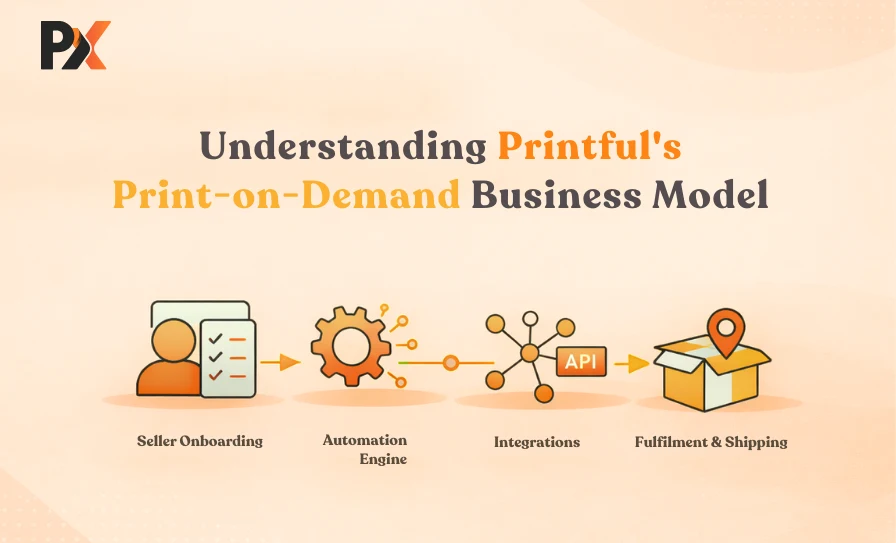
The foundation of Printful’s success in print-on-demand lies in its platform architecture. For example, a seller can upload a new design once, and orders from all their storefronts automatically move to fulfillment, without emails or manual work. It’s this seamless connection between sellers, storefronts, and production that turns complexity into smooth, predictable operations.
Key elements of the Printful business model include:
- Automated seller onboarding and product setup
- Deep eCommerce integrations (Shopify, WooCommerce, Etsy, and more)
- Real-time order routing to production facilities
- Automated fulfillment status updates and tracking
This model means orders flow from digital storefronts directly into production queues, bypassing manual intake steps that slow traditional shops down. Printful turned operational discipline — not just product depth — into a competitive edge.
Unlike traditional service printers that quote jobs manually, this platform-driven approach thrives on predictable volume and repeatability. That’s a defining element of print-on-demand success at scale.
Lesson #1: Make Ordering Simple — Self-Service for Print-on-Demand Success
One of the cornerstones of Printful’s success in print-on-demand is an intuitive, self-service ordering experience. Sellers can create products, upload artwork, set pricing, connect storefronts, and automate fulfillment — all without contacting support or sales teams.
For many print shops, this is a radical shift. Manual quotes, artwork emails, and attachment-based job instructions feel familiar, but they quietly create bottlenecks that limit growth. Every extra touchpoint adds time, increases the chance for errors, and slows down throughput.
If you’ve worked in print long enough, you’ve probably seen how much capacity slips away when repeat orders need CSR involvement. When your customers can design and place orders on their own, your process becomes smoother and more repeatable, turnaround times get faster, and your team can finally focus on the high-value, complex work that truly needs their expertise.
Decision-Maker Questions to Consider:
- Can customers reorder without contacting your team?
- Does your system automatically validate artwork and specifications?
- Are repeat SKUs and templates structured for rapid reuse?
Answer these questions honestly, and you’ll quickly see the truth: if your shop is built to scale — or are tiny operational gremlins quietly keeping a lid on your growth.
| Expert Tip: If your repeat orders still need manual intervention, your intake system—not your presses or staff—is the real growth limiter. Fixing this at the front end immediately unlocks hidden capacity and prepares your shop for sustainable scale. |
Lesson #2: Automate Workflows — Eliminate Manual Drag
If ordering is simplified, the next bottleneck is internal workflow. One of the biggest operational differentiators behind the Printful business model is automation.
In Printful’s ecosystem:
- Orders reach production without manual export/import
- Artwork validation and production instructions flow automatically
- Fulfillment updates sync back to storefronts
- Status tracking is real-time and transparent
For businesses relying on spreadsheets, PDF proofs, and inbox coordination, scaling past a few hundred orders per day becomes a lot more chaotic.
Why Automation Determines Scalability
Automation decides whether growth strengthens your margins or strains your operations. When orders flow straight from the storefront into production without manual handling, the economics change.
It enables you to:
- Lower labor cost per order
- Reduce turnaround time
- Minimize errors caused by data re-entry
- Let skilled staff focus on complex, high-value jobs
Manual touchpoints, emails, spreadsheets, disconnected systems, might work at low volumes. As order counts rise, they slow everything down. What feels manageable at 100 orders per day quickly turns into friction at 1,000.
Automated job routing, artwork checks, and production sequencing create consistency. This automation backbone is another reason Printful success in print-on-demand remains sustainable rather than chaotic. Growth becomes controlled instead of reactive.
Explore how automated workflow orchestration can support scalable print-on-demand operations without increasing overhead.
Lesson #3: Integrate Seamlessly Across eCommerce Channels
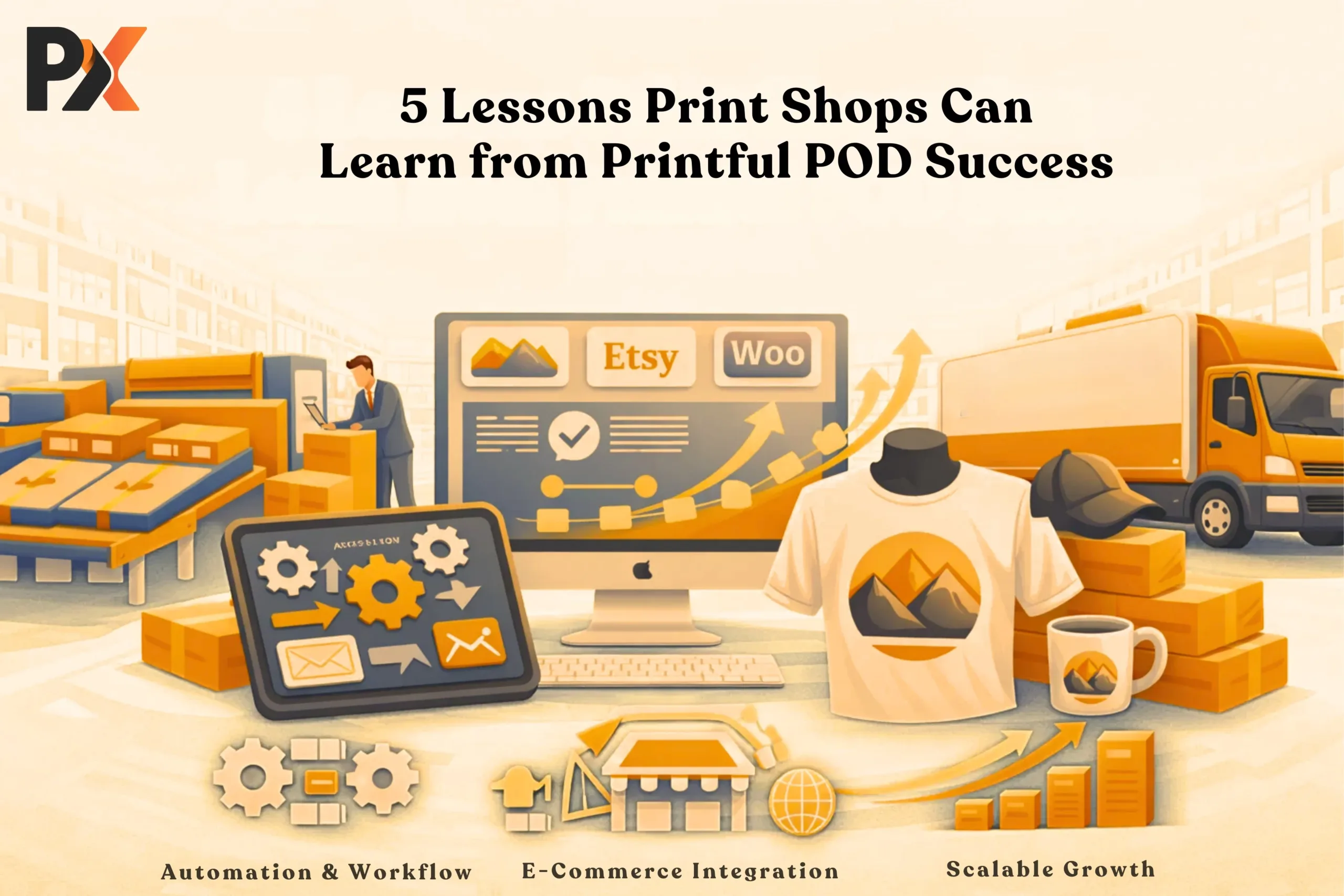
The beauty of the Printful model is simple: you can sell everywhere while fulfillment stays centralized and steady. Orders from Shopify, WooCommerce, or Etsy all flow into one structured production system — clean, predictable, no scrambling.
Now look at your shop. Your clients are selling on multiple channels at once. If your systems don’t connect smoothly with theirs, friction shows up fast. Usually like this:
- Orders needing manual checks
- Duplicate file submissions
- Small errors slipping into production
- Teams reacting instead of planning
It may seem minor in the moment, but over time it drains focus and profit. Strong integration also builds quiet loyalty. When your platform connects directly to a client’s storefront, switching providers becomes complicated — which makes staying the easier choice.
So here’s the real question: can your operation handle multiple storefronts without everyone holding their breath? Real growth comes from connected systems, simple onboarding, and fulfillment that scales without drama. As order volumes rise, your operation shouldn’t feel stretched — it should feel steady and ready.
Lesson #4: Think Platform — Not Just Print
One of the most overlooked aspects of Printful’s growth is its platform mindset. It serves thousands of independent sellers under a unified operational backbone.
For print businesses, this offers a big opportunity. Instead of functioning only as a traditional job-based service provider, a shop can become a controlled marketplace ecosystem. The difference is subtle but powerful: you let multiple sellers operate independently while maintaining control over pricing, quality, and production schedules.
Now, here’s the challenge most shops face: can your current system handle multiple resellers under one backend without creating chaos? If it can, each seller becomes another revenue stream, and presses run more consistently. If it can’t, every new account adds manual work, creates bottlenecks, and limits your growth to the pace of your team.
The good news? With the right infrastructure — centralized dashboards, automated workflows, and clear production visibility — this platform approach isn’t just a dream. Multiple clients, storefronts, and order streams can run like a well-choreographed dance, while your team finally spends more time on quality prints and less time putting out operational fires.
Lesson #5: Design for Scalability Before It’s Needed
Growth is exciting — until it starts testing your operations.
Across the print-on-demand industry, demand continues to rise, particularly in regions supported by strong eCommerce and logistics networks. As more customers seek personalized products, order volumes naturally increase.
But growth has a way of revealing operational gaps. Consider a shop that wins a large merchandise contract and suddenly sees orders double. If workflows rely on spreadsheets or manual checks, pressure builds quickly:
- Deadlines become harder to meet
- Errors increase due to manual handling
- Production teams shift into reactive mode
- Margins shrink under operational strain
Scalable infrastructure changes that outcome. When workflows connect and data shows up in real time, growth stops feeling scary. Your team plans ahead, balances capacity smartly, and keeps margins happily intact.
Over time, competitive advantage shifts. It’s not just about having good equipment; it’s about having systems strong enough to support sustained demand. The real question isn’t simply how to grow sales — it’s whether operations can handle that growth without sacrificing profitability.
Scalability isn’t just a technical improvement. It’s a strategic safeguard for long-term stability.
How PrintXpand Helps Apply the Printful Success Framework
The core lesson from Printful’s success in print-on-demand is not about product diversification. It is about operational orchestration.
PrintXpand enables print businesses to implement similar infrastructure principles while retaining ownership of clients, margins, and brand equity. Through structured web-to-print ordering, automated workflows, integration frameworks, and marketplace enablement, PrintXpand equips printers to align with modern commerce expectations.
Instead of outsourcing fulfillment, print businesses can internalize platform capability. That strategic shift transforms growth from labor-dependent expansion to infrastructure-driven scalability.
Build your own scalable print-on-demand platform that grows with your business.[a]