



Summary
With the increasing virtualization of products and services, the need to provide outstanding customer service is now more important than ever. Many companies and industry experts suggest adopting new procedures, such as customization, to meet each and every customer request. However,due to the diverse needs of customers, this approach has become a surefire way to add unnecessary costs and complications to operations.
Companies all over the world have embraced customization. They want to provide unique value to their customers and improve the collective brand impression. The readily available technology and flexible workflows have made this possible. All this at relatively lower costs. Companies have discovered that customization has some drawbacks, if not many. As they get more into the business, they realize that they did not thoroughly examine the kinds of customization their customers value.
The more you look into the trends, the more you find that many start-ups and established companies fail to implement product customization. While product customization works well for many entrepreneurs, it is also challenging and difficult to implement. In this guide, we will take a closer look at the reasons for the failure of product customization and in what areas improvements can be made for maximum returns!
Top 5 Challenges of Product Customization and How to Overcome
More and more businesses are embracing product personalization to stay competitive and meet evolving customer expectations. But while it sounds impressive, it also comes with its own set of challenges. So, let’s explore five key challenges of product personalization and practical tips and strategies to help you overcome them.
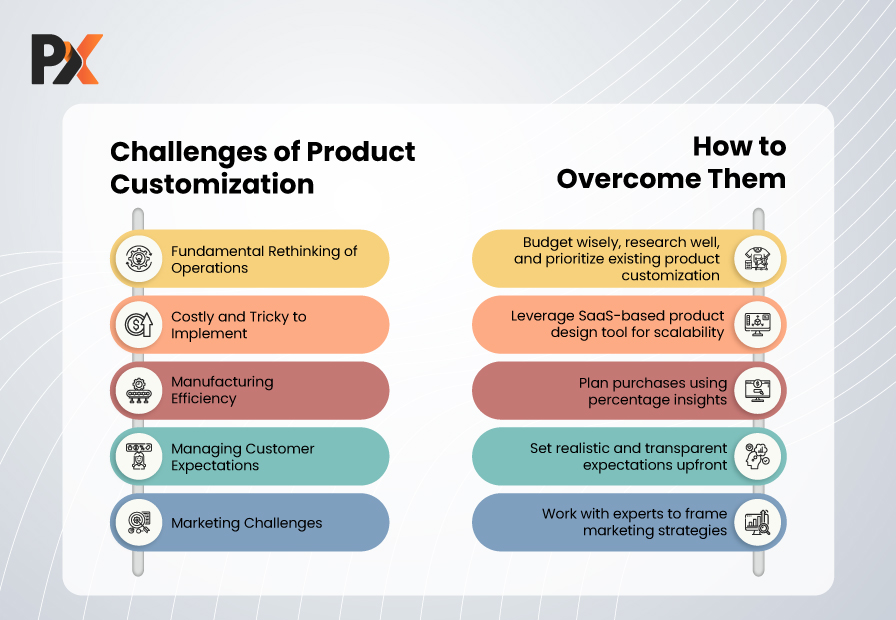
Fundamental Rethinking of Operations
The first and most important challenge that product customization enforces is the fundamental rethinking of operations. Everything from web design to order management, shipping, the the way the operations run. Everything from web design to order management, shipping, manufacturing process, equipment, and so on needs replanning.
Once entrepreneurs decide to include customization, they must also consider all the equipment to fulfill the customization demands. These changes need to be accommodated accurately and must comply with industry standards. Companies need to ensure that their processes scale efficiently and are agile enough to adapt to changes that the customer demands.
Let’s look at an example of one of the world’s largest garden equipment manufacturers: John Deere. To keep up with evolving industry standards and customization, they started to offer more products, which eventually resulted in a proliferation of parts and processes. The company, despite being aware of this, stubbornly resisted simplifying its product offerings. They did manage to make their value chain more flexible, but only after realizing the complexity was beginning to impact efficiency.
How to Overcome This?
There’s no one-size-fits-all solution to this challenge. Since product customization in the print industry is still an evolving space, clear roadmaps or standard approaches may be limited. That’s why it’s important to do thorough research. Use the information available and tailor it to fit your business model. If you’re expanding from your existing print business, define a clear budget for the new direction and allocate it wisely. Start by offering customization on your current products rather than introducing entirely new ones. Monitor the results, gather feedback, and adjust your strategy as needed. Build a plan that works for your business and grow from there.
Costly and Difficult to Implement
While it may look good in theory, the implementation part is a tough one. Product customization on eCommerce websites is not the easiest to apply. Even many customers would not be able to follow through. With a product designer tool, it becomes more difficult to see a spike in sales. This is generally due to the wide range of options that customization provides.
The customization software for printing business gives users many options, which they may not be interested in. However, with some designer tools, you can select the features that you think are needed. You can also restrict designing to selected areas of your product.
However, getting a customization platform designed specifically for your website is usually very expensive.
This is why working with experts and finding a cost-effective product designer tool is important. We have something that fits this description exactly.
Are you planning to elevate your printing process? Discover the power of our web to print services today.
How to Overcome This?
There is only one way to solve this problem, and that is to face it and deal with it mindfully. Many product design companies offer a SaaS-based product design tool on your website for a fixed monthly fee. You can set it up instantly on your website.
However, professionals like PrintXpand, offer business owners control over the customization experience. Further, they offer free support, service, and upgrades for the initial few months. The biggest advantage of using a product designer tool is that scaling becomes easy. It provides the latest design features and a simple and quick upgrade whenever needed.
3. Manufacturing Efficiency
Setting up and implementing the product customization process can alter things at a very core level of your print business. For each and every customized product, you will need a different logistics method, as it will have its own design, shape, and size.
For a business model, it is impossible to predict all the different combinations of designs from your offerings. This enables various challenges for mass customization.
-
- Production Timeline
The production timelines of customized products are different from regular products produced in bulk. products. Many additional factors also contribute to extending the timeline. Such as changing the printing process to fit customized designs, the time taken to convert files into printable formats, and so on.
-
- Inventory Management
It is impossible to predict the designs that customers will order, making inventory stocking a huge challenge. If the demand exceeds your capacity, you will find yourself in a pool of problems and lose revenue. You can stockpile excess inventory, but it will then include warehouse costs, too.
-
- 3rd Party Vendors
Many businesses depend on vendors for supplies used in for the production process. This demand will be variable for customization businesses, and the vendors might not be able to accommodate these orders.
How to Overcome This?
To prevent the above-mentioned product customization challenges, you can plan the purchases by getting insights from your existing business. Make a list of the percentage of raw material quantity needed instead of listing the actual quantity.
You can obtain these percentages by studying your overall trends, past order trends, and customer behavior. You can also invest in a product design tool that does this. For example, PrintXpand’s product design tools, provide you with print-ready design files compatible with all printing methods, such as, Screen Printing, DTG, Sublimation, Laser engraving, and so on.
4. Managing Customer Expectations
The print industry is highly competitive, with companies offering discounts, competitive pricing, same-day deliveries, etc. Hence, customers always expect more from your business. Product customization increases prices and enforces longer delivery timelines. As a result, many customers may not choose the customization process.
Further, a return policy will not be possible when you manufacture unique products for individual customers. Even if you allow returns on personalized products, you’ll likely bear the full cost, since those items can’t be resold; they can affect your margins. With most eCommerce businesses offering a “no-questions-asked” return policy, how will you sustain it?
How to Overcome This?
Customer insights can help you manage customer expectations. So, when writing your policies, make it clear on your website and web content that you offer a premium service with customization. This way, you can justify your pricing and production time. If you charge extra for each customization element, mention it before your customers start designing. This will save them both time and effort. Plus, customers appreciate upfront honesty and transparency.
You can also promote transparency by offering live pricing during the customization process and design preview options to edit and modify at all stages of the order. Click the link below to explore all the features of the Product Designer Tool.
5. Marketing Challenges
For print service providers, the target group is not only about spotting differences. Marketers also need to identify similar needs. Traditional marketers often lack knowledge and tools, which makes them more likely to face product customization challenges. Moreover, things get crazier when they start adding more variety to their product lines. Marketing trends may help a little, but relying solely on the trends of the past isn’t a solution one should opt for.
How to Overcome This?
As the entire print industry is still evolving, few strategies exist to market these products correctly. So, we recommend that you work with experts on this. Talk to print industry experts who have been working in this area for a while and research the current trends to frame marketing strategies.
So, those were the key product customization challenges and solutions mapped out for you. If you wish to read more about customization software for printing business or product customization in general, head over to our knowledge hub.
5 Key Benefits of Product Customization
Nowadays, brands are aware that personalization creates value for customers. Considering the opportunities it provides, it is easier to start offering product customization. Here are some more reasons why it can be a great idea for your print business.
1. Generate More Sales
Not only does the personalized product have the potential to skyrocket sales, but it also builds brand loyalty and generates word-of-mouth publicity.
Recent statistics indicate a strong consumer demand for personalized products and services. According to recent data, 81% of consumers say that they ignore irrelevant marketing messages.
This indicates a shift in the general consumer mentality away from the economic cost and towards the product’s inherent value.
2. Amplify Profit Margin
Most traditional printers buy raw materials from third-party manufacturers. The traditional business model always risks businesses by stockpiling the products in bulk, with no guarantee that the entire stockpile will sell. With remote printing businesses and start-ups, entrepreneurs are no longer required to print several identical items in the hope of making a profit. With just a digital printer and a desktop computer, anyone can operate efficiently while reducing the need for outsourcing.
3. Makes You Unique
Consumers surely love to shop at stores that have hundreds of different products. Let us assume there’s a store with an enormous catalog with different images and patterns of its products. There’s another store where they could just walk in and ask for products with any image they want, such as a quote, a cartoon, a superhero character, a family photo, and so on.
Given a choice, most people will always choose the latter to get their dream product design. This proves to be extremely lucrative for companies offering customization. Customers are more likely to see these businesses as unique and out of the box. This can make a huge difference in their buying decision-making process.
You can take this further by letting customers personalize products themselves, in short, giving them a next-level interactive experience. With the help of product designer software, this is easier than ever to implement.
If you’re interested in offering customization but aren’t sure where to begin, start with the products you already sell. For instance, if you offer bags or clutches, consider investing in the necessary equipment and software to allow customer-driven customization.
Whether you’re adding customization options or offering fully personalized products, the required investment is relatively small. However, it can substantially increase the value and markup of your existing product line.
Check more details about PrintXpand Customization Software to design your products. It is a fully responsive designer tool and is perfect for creating personalized designs on every printable material.
4. Expand Your Existing Printing Business
The biggest benefit of product customization is that existing print companies do not need to trash their business model or throw out all the existing equipment to buy fresh ones. All they need to do is branch out of their existing business and increase their inventory.
All they will need is a product customization tool to design your ideas. They may require software like a print job manager, inventory manager, etc. It all boils down to individual needs. Print ERP software can help you easily manage the existing and new functions that are introduced after you decide to go for customization.
Thus, web-to-print solutions make integrating customization into your existing product line very convenient. These solutions include everything from a designer tool for effortless customization to print ERP software for efficiently managing your entire printing firm.
Supercharge your print business with Print ERP and revolutionize your product customization.
5. Increase Customer Loyalty
Product customization is one of the best ways to build brand loyalty. It results in positive experiences that lead to higher customer satisfaction and better conversion rates. When customers can personalize products according to their taste, they get exactly what they want, and their satisfaction level goes up to 101! They see the product as a unique item with added value made just for them! If your customers feel they have your undivided attention, they will likely establish a lasting relationship with your brand.
Customer data can work wonders for you, too. Knowing consumer trends and buying habits is a powerful tool in any business. Customer insights give you a strong competitive advantage. Normal businesses can only gather data and feedback on their stock items. Product customization gives you an edge. You can know your customers in ways their competitors can’t come close to!
Summing It Up
In this blog, we’ve covered some of the most common product customization challenges businesses face when moving toward product customization. We also looked at the benefits and drawbacks, along with a few practical tips to help you get started and succeed in this space.
The shift from a product-focused model to a customer-centric one isn’t always easy. Many companies struggle to adapt because the traditional print industry is built around a fixed way of thinking. That mindset, shaped by years of established habits, isn’t always aligned with the demands of today’s market. But product customization is all about delivering value through personalization, and that requires a fresh, more flexible approach in terms of the tools used along with the thinking.
Of course, like any big change, there are challenges. But with the right customization software for printing business, product personalization can become a powerful, scalable part of your operations.
At PrintXpand, we’re here to help you make that shift. Our team of dedicated developers is focused on creating modern, reliable solutions tailored to your business.
Connect with them right away!
All product and company names are trademarks™, registered® or copyright© trademarks of their respective holders. Use of them does not imply any affiliation with or endorsement by them.