



Custom print orders used to arrive via email. Or WhatsApp. Sometimes just a phone call. Hard to imagine now, isn’t it? Today’s customers demand seamless ordering and extensive customization options. They’ll design something at midnight and expect it shipped within days.
The gap between what buyers expect and what old workflows deliver keeps increasing. Demand has surged. Complexity has multiplied. And yet—most shops are still stuck in email chaos, spreadsheet tangles, and jobs bouncing between five people before anything actually prints.
That’s exhausting. That’s expensive. A well-structured web-to-print workflow changes everything by creating a single, continuous path from your website to your production floor. This blog covers what that looks like in practice, why it should matter to your operation, and how clinging to outdated processes is costing you more than you realize.
What Is a Web-to-Print Workflow?
A web-to-print workflow covers every step of print business from “customer clicks order” to “package delivered.” Design, approval, prepress, production, shipping—all of it, linked together.
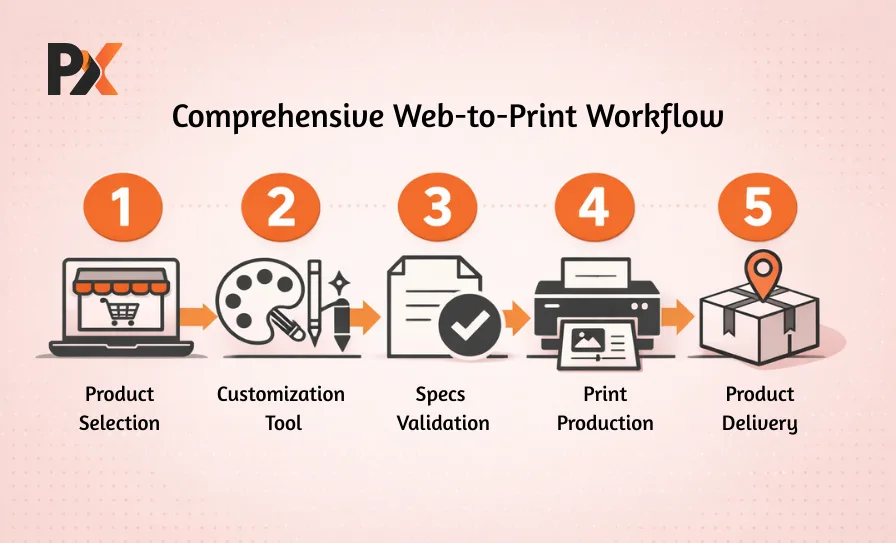
Picture this scenario: Someone lands on your site at 2 AM, customizes business cards using your design tool, picks their paper stock, and checks out. What happens next? With a proper web-to-print system, their file is automatically checked for resolution issues. Job details populate in your production queue without anyone having to touch a keyboard. The customer receives confirmation immediately without requiring your team to intervene.
This is what makes everything click—online ordering that genuinely connects with your backend. No entering the same data twice. No scrambling for missing specifications. No last-minute panic of “hold on, which paper did they actually choose?”
Does every print business benefit from this? Absolutely. But the transformation hits hardest for commercial printers swamped with orders, franchises wrestling to maintain brand consistency across hundreds of locations, and enterprise accounts where a single logo mishap turns into a $50,000 mistake.
Why Web-to-Print Workflow Is Important for Print Businesses
To help you understand this with an example, let’s say a customer emails a file in the wrong format. Your prepress guy opens it Tuesday morning, spots the 72 DPI images, and fires back an email. Radio silence for three days. Meanwhile, someone in accounting quotes the job in her spreadsheet. Approvals occur in an email chain with 17 replies and 4 people CC’d who have no idea what’s happening.
By Friday, you are ready to print. Maybe. This is the challenge that web-to-print automation aims to resolve. Especially with faster services from large ecommerce companies like Amazon, print businesses need to make their processes more efficient.
A structured web-to-print process flips the script entirely. Orders enter your system one way—the right way. File problems get flagged before your prepress team even sees them. Approvals happen inside a dashboard where nothing gets buried.
What does this actually get you?
Jobs move faster because nobody’s waiting around for handoffs. Accuracy improves because the system captures specifications exactly as ordered—no telephone game between departments. And here’s the big one: you handle way more orders without hiring proportionally more people.
Web-to-print automation basically turns your operation from reactive chaos into something you can actually manage. Your team stops playing whack-a-mole with problems and starts focusing on, you know, actually printing things and talking to customers.
Common Challenges in Web-to-Print Workflow Management
Here is the thing though, going digital doesn’t automatically solve everything. Plenty of shops hit walls even after investing in new systems. Knowing these pitfalls upfront saves headaches later.
File disasters and approval bottlenecks cause the most issues. Customers upload phone photos for banner prints. They submit RGB files for CMYK jobs. Without automated checks catching this stuff early, your prepress team becomes a very expensive quality control department. And approvals? If those still require chasing people via email, jobs sit idle for days.
Disconnected production systems create another headache entirely. Your storefront looks amazing, takes orders perfectly, and then someone prints the job ticket and walks it to the back. Seriously. The digital chain snaps, and suddenly you’re back to manual tracking.
The visibility black hole frustrates everyone. Customers call asking, “Where’s my stuff?” and your team scrambles to find answers. You can’t see which jobs are stuck, which are flowing, which need attention right now.
Then there’s the volume problem. Systems that handle fifty daily orders sometimes completely choke at five hundred. Peak season hits, and suddenly your “automated” workflow needs ten temps doing manual data entry. Not exactly the efficiency you paid for.
How PrintXpand Optimizes the Web to Print Workflow
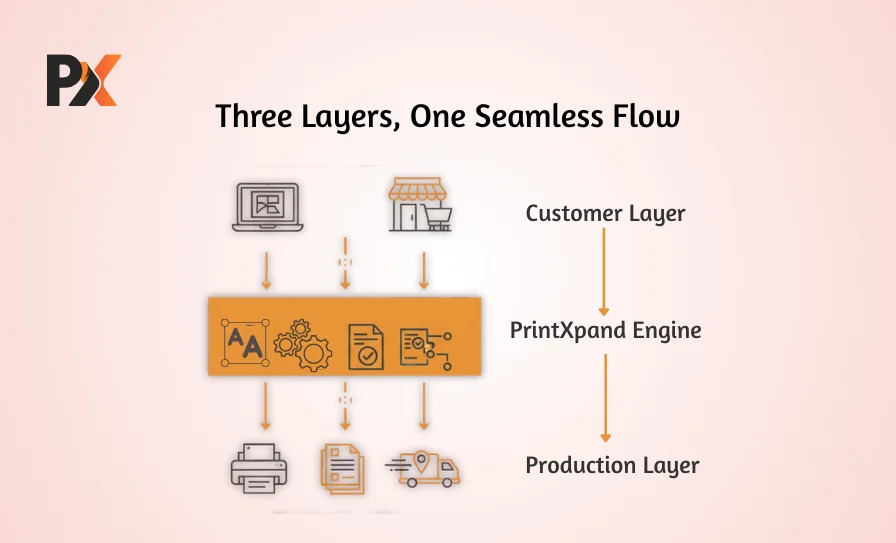
PrintXpand exists because generic ecommerce platforms don’t understand print. They’re built for selling shoes or electronics, then awkwardly retrofitted for custom products. PrintXpand started with print operations in mind from day one.
What makes the difference? True end-to-end web-to-print workflow connection. Customer places order, files validate automatically, job enters production queue with correct specs, status updates flow back to the customer portal. One continuous thread, no breaks, no manual bridges.
Your customers get powerful design tools and a smooth ordering experience. Your production team gets verified, print-ready jobs with everything they need attached. You get to actually see what’s happening across your entire operation without chasing people down for updates.
Variable data jobs? Handled. Mixed B2B and B2C channels? No problem. Complex personalization with dozens of options? PrintXpand was built to manage exactly this kind of complexity in the print industry.
Key Workflow Advantages with PrintXpand
Orders flow straight to production without sitting in anyone’s inbox. Customer checks out, job enters your queue, and files are ready to print. Your team operates presses rather than processing paperwork. Wild concept, right?
Proofing and approval happens in one place. Customers review soft proofs directly in the platform—no downloading PDFs, marking them up, emailing back and forth. They approve, it’s logged, job moves forward. Need revisions? System routes the new file back through validation automatically. Everything’s tracked, timestamped, and audit-ready.
Real-time tracking changes everything. Production managers see exactly what’s queued, running, and shipping. Customer service answers questions instantly instead of saying, “Let me check and call you back.” Customers track their own orders without picking up the phone.
Your existing tools stay in the picture. PrintXpand’s web-to-print automation integrates with the print MIS and production systems you’ve already invested in. Data flows where it needs to go. No duplicate entry, no “which version is current” confusion.
B2B and B2C work together finally. Corporate clients get branded portals with approval chains and budget controls. Retail customers get consumer-friendly shopping experiences. Both feed the same production workflow. One system, multiple channels, zero headaches, juggling separate platforms.
Why PrintXpand Stands Out
Here’s what separates PrintXpand from the crowd: it’s built exclusively for print. Not adapted from retail software. Not a project management tool with print features bolted on. Every single capability exists because actual print businesses needed it.
That focus shows up in flexibility. Your workflow likely differs from the shop across town. PrintXpand doesn’t force you into someone else’s template. Configure approval steps, routing rules, and integrations to match how your operation actually runs—not how some software developer imagined it might work.
The whole point is eliminating the errors and delays that quietly drain your profits. Catching file problems before they reach prepress. Keeping jobs from falling through the cracks. Making sure everyone works from the same accurate information. Fewer reprints, faster turnarounds, customers who actually come back.
And, PrintXpand makes that happen.
Closing Lines
Look, a solid web-to-print workflow isn’t just a fancy upgrade anymore. It’s baseline infrastructure for any print business that wants to stay competitive. The shops that are still relying on emails and spreadsheets are slowly bleeding money and customers to competitors who have figured this out.
Eventually, those who understand and embrace this shift will be able to not only sustain themselves but also predict and lead the future market trends. PrintXpand is the enabler that can help you unlock those capabilities.
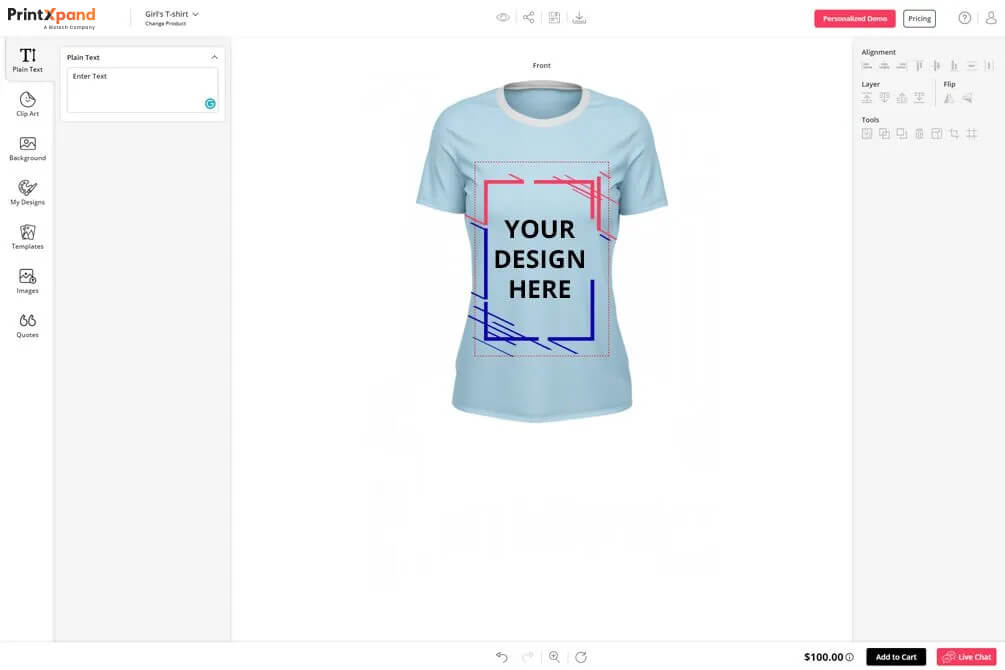
It is a comprehensive solution that offers everything, from a user-friendly design tool interface to real-time price calculator, and order management solution. PrintXpand becomes the bridge that helps you build workflows that actually work—without compromise or duct-tape solutions.
Ready to see the difference a purpose-built web-to-print system makes for your operation?