



The commercial printing industry is huge. A big printing firm is cranking tens of thousands of marketing brochures for corporate clients, while a little digital printing shop across the street is doing like 50 custom wedding invitations for a couple that just walked in.
Print industry has been around since Gutenberg. Longer if you count woodblock printing in Asia. Point is, it’s old. Really old. But right now? Things are getting complicated way too fast.
All the raw resources—paper, cloth, inks, machines—are getting more expensive by the day. Even customer expectations are changing rapidly. Nobody wants a one-size-fits-all solution anymore; they need something unique, personalized, and tailored to them. Yes, all of these things are possible. In fact, tons of print shop owners are implementing them right now.
If you’re wondering how, then the answer is simple technology. Automation is changing everything from how you take orders to how jobs move through your shop. The shops figuring this out are doing well. Those still doubting this may be in serious trouble before they even realize what hit them.
Many print business owners are confused about where to begin and what to focus on. Thanks to the increasing diversity and complexity, it’s not an easy feat either. But knowing some popular commercial printing industry trends might help, and that’s exactly what this blog will cover.
Current State of the Commercial Printing Industry
Walk into any printing conference, and the divide between shops is pretty stark. You’ll see businesses that invested heavily in offset presses and are seeking specific jobs that align with their capabilities.
For instance, if a customer needs 50,000 identical brochures? Offset is probably your answer. But digital? Digital has eaten up a massive chunk of the market in the past few years, especially when turnaround time matters, or you’re handling variable-data projects.
Most successful shops are running both nowadays. They’re not tied to a single technology, so if the job specifications make sense for offset? They run it there. Job works better on digital equipment? Fine, use that instead. Simple as that. It’s not about loyalty to specific equipment, it’s about using whatever keeps you profitable on each individual job.
Demand patterns look completely different from what they did even five years back. B2B printing hasn’t vanished (companies still need marketing materials, packaging, and branded materials), but expectations have shifted dramatically.
Nobody wants to wait two weeks when your competitor across town can deliver in three days. They want options. Multiple finishing choices. Customization capabilities that straight up didn’t exist before.
Meanwhile, B2C demand has absolutely exploded in specific niches. Personalized merchandise, photo products, custom t-shirts, and consumers ordering directly through websites. This market was essentially nonexistent a decade ago. Now it’s massive. Print shops that figured out how to serve individual consumers online? They’re doing great.
Here’s the biggest change, though: software now runs these businesses. Not design software like Adobe—everyone has that. The actual backend systems managing your quotes, tracking where orders are, scheduling production runs, all that operational stuff.
So, if you’re still tracking jobs on a whiteboard and estimating prices by pulling numbers from your head or old Excel files, you’re competing against shops that automated this years ago. And everyone knows who wins this race.
Top Commercial Printing Industry Trends to Watch in 2026
The transformative functionalities of digital tools are gonna shape the future of commercial printing, and these trends are proof of that:
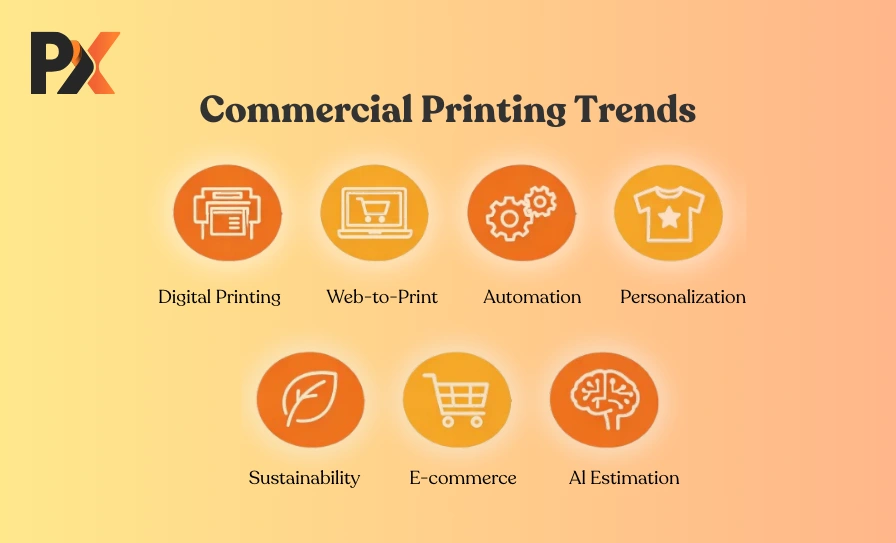
Digital Printing Continues to Dominate
Digital printing quality has reached a point where customers genuinely cannot tell the difference between digital and offset output. The quality gap closed. Color accuracy improved dramatically. Modern digital presses handle substrates that would’ve jammed machines five years ago. And speed? Not even worth comparing to where things were.
Statistics tell the real story, though. The demand for offset litho has fallen by 2.5% CAGR from $354.4B in 2019 and is forecast to continue declining to $307.9B by 2029. While digital printing is growing rapidly, it stood at $165.5B in 2024 and is expected to grow at 4.8% by 2029. (source)
And for print businesses, it also kind of makes sense.
When you’re not making plates, and you can literally start printing the second a file is approved, suddenly running 50 pieces becomes profitable. Customer calls frantically needing 100 customized brochures by tomorrow morning? Sure, no problem. Try pulling that off with offset and watch what happens to your margins. They vanish into thin air.
Here’s what one needs to remember, though—digital didn’t kill offset as everyone predicted back in the day. They work together in most successful operations now. Smart shop owners figured out they don’t need to pick sides in some format war. They have both technologies sitting on their production floor, and they route each job based on simple math. What makes money? That’s the only question.
Your customers don’t care which press their jobs run on, anyway. They care about quality, speed, and price. Hit those three marks, and they’ll keep ordering. Miss even one? They’re gone.
Web-to-Print Adoption Is Becoming Standard
Having an online ordering system a few years ago was a luxury feature. Made your shop look modern and tech-savvy. Now? It’s basically required just to compete. Customers want to browse product options at 11 PM on Tuesday, upload files, see accurate pricing immediately, and place orders without picking up the phone.
Commercial printing industry trends indicate that even smaller shops are implementing web-to-print systems because that’s just how people shop now. COVID pushed this transition forward probably five years in about six months. Once businesses got comfortable ordering everything online, they didn’t revert to phone calls and emails.
The platforms have gotten incredibly sophisticated, too. Modern web-to-print systems handle complex designs and provide live previews that render accurately. They integrate with design software that people already use.
These tools let you manage entire corporate brand asset libraries for your enterprise clients. You can also set up pricing calculations based on dozens of variables—paper choice, quantity breaks, finishing options, rush fees, and shipping zones. Some platforms even route approved jobs directly to production equipment without human intervention.
Why does this matter for your business? It solves problems you might not even realize are costing serious money. Way less back-and-forth with customers trying to nail down quote details. Fewer mistakes from someone manually entering order information. Your staff can focus on producing instead of spending half their day answering phone calls about pricing and availability.
Automation & Print Workflow Software
Every manual step in your production workflow is burning money. Someone re-typing customer information that already exists in another system somewhere? That’s wasted time, wasted money. Emailing proofs back and forth seventeen times, trying to get approval? Wasted time. Walking out to the press floor every twenty minutes to check if a particular job finished? You see where this goes.
Workflow automation is changing how print operations function. Now systems can automatically preflight incoming files, apply pages correctly for your specific equipment, manage color profiles, and route jobs to the appropriate production equipment. The customer approves a proof via your online portal, and the job is added to the production queue with the specifications already loaded.
But the best part is that everything connects properly. Your web-to-print system connects to your print MIS, which in turn communicates with your actual production equipment. Customer information gets entered once. System tracks everything automatically from that point—which jobs are in production, material consumption, how long each stage actually takes, whether you’re making money on jobs or losing money.
This isn’t just about saving time, though obviously that matters. It’s about visibility into what’s actually happening in your facility. You can identify bottlenecks before they become serious problems. Figure out whether you genuinely need that new piece of equipment you’ve been eyeing or whether you just need better production scheduling.
It also gives you space to make staffing decisions based on actual data rather than gut feelings. Shops that embraced workflow automation early? They’re running circles around competitors still doing things manually.
Personalization & Variable Data Printing
Generic products don’t work anymore. Consumers want items that are made specifically for them. Businesses want marketing materials that speak directly to individual recipients, not a bland message aimed at everybody and nobody.
Variable data printing makes this possible at a real scale. Every printed piece can be personalized with different names, images, graphics, or layouts—yet all driven by a single database of information.
You could run a direct mail campaign printing 5,000 postcards where every single one is unique, customized based on each person’s purchase history, demographic data, or whatever targeting criteria makes sense for that campaign.
The best part is its versatility. Customization can be something as simple as different photo book designs based on customer choices to personalized packaging and messages with individual names. You can also try custom labels for limited edition products or unique promotional items. Basically, any case where personalization adds value? That’s a potential opportunity for growth.
For print shops, VDP requires investment upfront. You need digital presses capable of handling variable data efficiently without slowing to a crawl. Software to manage databases and generate design variations. Workflows to proof variable jobs without losing your mind checking thousands of unique pieces. But customers pay premium prices for personalization, so margins usually justify the effort and capital investment.
Sustainability & Eco-Friendly Printing
Environment concerns aren’t some passing fad that’ll fade away next year. If anything, pressure is intensifying every single day. Younger demographics are actively seeking businesses that demonstrate they actually care about environmental impact. For print companies, this means genuinely rethinking materials, processes, waste management, energy consumption—all of it.
Serious demand exists now for recycled papers, FSC-certified stock, soy-based inks, vegetable-based inks, chemical-free printing processes. Some shops are going all-in with solar panel installations on their roofs, comprehensive recycling programs, pursuing eco-certifications to prove they’re actually serious rather than just greenwashing.
Sustainability isn’t only about what materials you choose, though. It’s also about not wasting stuff unnecessarily. Better prepress processes reduce spoilage. Optimized press setups minimize throwaway sheets during makeready. Using digital printing reduces the chances of overproducing and having unsold inventory sitting around. All that helps the environment AND improves your financial performance.
Printers succeeding with sustainability aren’t just writing “eco-friendly” on their website and calling it done. They’re making substantive operational changes and being transparent about actual practices. Customers can easily tell the difference between real commitment and greenwashing.
Integration with E-commerce & Marketplaces
Print businesses are selling through every channel they can access nowadays. Own website, obviously. But also Amazon, Etsy, eBay, and specialized print marketplaces. Some shops white-label their entire service for other companies. Others partner with fulfillment platforms, reaching customers they’d never find otherwise.
Multi-channel selling opens massive markets but creates operational nightmares without proper systems. Manual inventory management for multiple channels? Handling pricing everywhere without a proper system? Using legacy systems for order fulfillment? Recipes for absolute disaster.
Successful operations use software that synchronizes everything automatically. Order comes in from any channel, flows into central management system, gets produced and shipped using consistent processes regardless of origin. Doesn’t matter if it came from your website or Amazon or Etsy—same process.
E-commerce integration means matching their customer expectations too. They expect free shipping. Easy returns. Instant order tracking with real updates. Fast delivery. Print businesses that used to quote week-long turnarounds are compressing that timeline down to days or even same-day for certain products. That’s the new normal.
AI & Smart Estimation in Printing
AI is starting to impact commercial printing in ways that actually matter for daily operations. Not just buzzwords—actual practical stuff. Most immediate application? Job estimation and pricing. Traditionally, you needed estimators with years of experience, understanding every variable and all the little factors affecting whether you make money on jobs or not.
AI-powered systems analyze job specifications and generate accurate quotes instantly. They learn from your historical data and improve over time. They suggest alternative specifications that might save costs. Predict production times based on current shop capacity and existing workload. Even flag jobs that might have problems based on similar past work. Pretty cool, right?
Beyond pricing, AI can scan printed sheets in real-time, catching defects before they become expensive mistakes that cost you thousands. Predictive maintenance fixes equipment before they break, avoiding emergency downtime (which is the worst). Optimizing production schedules in ways humans honestly can’t match. Machine Learning algorithms reduce waste by better predicting material requirements for each job.
While AI adoption for printing is still in its early stages, the trajectory is obvious. Print businesses leveraging these tools have concrete advantages in speed, accuracy, efficiency that manual processes simply cannot match anymore. Can’t even come close.
Got an industry trend you want to implement? Take the first step with experts who understand print businesses inside out. See how PrintXpand fits your specific needs and expands your business capabilities—from web-to-print to automation.
How to Prepare for The Commercial Printing Industry Trends
Understanding commercial printing industry trends is step one. Actually adapting your business to deal with them? That’s considerably harder. Way harder. If you’re wondering where to start, focus on digital transformation first. And no, that doesn’t mean replacing every piece of equipment in your facility—it means modernizing how information flows through your business.
Start identifying your biggest pain points. Where do orders get lost? Where does communication consistently break down between departments? Where do most errors happen? Nine times out of ten, problems trace straight back to disconnected systems and manual handoffs. Address those issues systematically instead of trying to overhaul everything simultaneously. One thing at a time.
Lots of print shops run on one system for generating quotes, another for job tracking, Excel spreadsheets for inventory management, and email for customer communication. This creates terrible data silos where information exists in one place but not others. People enter the same customer data five different times. Moving to centralized systems eliminates this mess entirely.
When evaluating print software options, consider scalability seriously. Something working perfectly fine for five employees might completely fall apart when you grow to twenty. Choose systems that actually expand with your business—more users, more features, more transaction capacity—without requiring complete replacement in a few years. Future-proof it.
Real-time visibility and automation should be absolutely non-negotiable at this point. You need to know what’s happening in your shop right now, not what happened yesterday or last week. Automated workflows drastically reduce errors and free your team to focus on work that actually adds value, rather than drowning in administrative nonsense nobody wants to do anyway.
Role of Print Management Software in the Future of Commercial Printing
Looking at the future of commercial printing, print management software sits right at the center of successful operations. Combination of print MIS and web-to-print platforms gives you actual tools to handle all the trends discussed in this article. Every single one.
Truly comprehensive print MIS handles estimating, order management, production tracking, inventory control, shipping, accounting—everything integrated properly. When you couple that with a solid web-to-print storefront, you get a powerful system that drives efficiency across your entire operation, from the moment customers place orders to final delivery. Beginning to end.
Benefits stack up remarkably fast. Efficiency increases because automation eliminates repetitive manual tasks nobody wants doing anyway. Data flows seamlessly between different operational areas without constant manual intervention.
Scalability improves because the software handles growing order volumes without requiring proportional increase in staff. You can grow without hiring proportionally more people. Profitability rises because you’ve got accurate estimation, reduced waste, faster turnaround times—everything contributing to healthier margins.
Print management software also provides the foundation you need to respond to web-to-print trends and modern customer expectations for customization, instant quotes, and 24/7 ordering. Without these systems in place, delivering the kind of customer experience people expect nowadays? Basically impossible. You can’t do it manually.
Stay Ahead of Commercial Printing Industry Trends with PrintXpand
The commercial printing industry is changing faster than most people realize. Way faster. Technology improvements, shifting customer expectations, intense competitive pressure—everything is pushing businesses to evolve or get left behind.
Print shops that are genuinely embracing digital transformation, automation, and customer-centric approaches? They’re gonna grow. Ones stuck doing things the old way? They’re gonna have an increasingly difficult time competing.
Success in this environment requires having the right tools in place. PrintXpand offers a comprehensive web-to-print solution for modern print businesses facing complex workflows.
Whether you need a powerful customer-facing storefront, sophisticated product customization capabilities, or seamless integration with existing systems—PrintXpand provides the technology foundation genuinely transforming how your operation runs.
Discover how PrintXpand’s web-to-print platform helps you capitalize on industry trends, delight your customers, and grow profitability in ways that actually make difference to your bottom line.
See exactly how our solution can work for your specific business needs and challenges.