



This story is about the Wide-format Print Shops across the GCC. Especially the wide-format print shops that often struggle keeping up with the delivery schedules. Imagine a printer in Dubai takes an urgent order for exhibition graphics with a three-day turnaround. The sales team promises quick delivery, but somewhere between design, prepress, and production, communication breaks down. The designer assumes printing has already started, while the operator waits for file approval. By the time the confusion clears, the deadline is missed.
Unhappy clients and general expectations of late delivery are the actual benchmark. While the majority of the shops run with similar benchmarks, we believe that it leaves an opportunity for an aware shop owner(s). Focus on building robust, transparent, and ready for tomorrow workflows that can help you have an edge in the traditional market scenario. Certainly cost vs the actual advantage is a real question here. And we will delve deeper into it, too.
PrintXpand aims to provide a web-to-print ERP solution that understands the wide-format printing operations. And, this is ready for integration esp. to the GCC print businesses. We aim to provide an out of box solution that can handle every step of the production process to be transparent for print automation and transparency, and to be able to track end-to-end print flow. Each team in your system understands exactly what needs to be done and when. Thus, allowing jobs to flow smoothly from order to delivery with no missed deadlines or confusion.
Why Manual Job Tracking Breaks Wide-Format Operations
Many wide-format printers across the GCC still depend on manual ways to track their jobs. Most of the teams use spreadsheets, calls, or chat groups to share updates. At first, this may seem convenient and manageable. But as job volumes start to increase, small inefficiencies begin creating bigger problems. And so, without a structured system in place, your sales, design, and production teams are left to work in isolation. This becomes difficult for anyone to know the exact status of a job in real time.
This fragmented communication is the main reason deadlines slip. A designer may finish artwork on time, but if prepress is not notified, files sit idle. Managers then spend hours chasing updates instead of planning capacity. The absence of a web-to-print MIS with job tracking creates repeated follow-ups, unclear ownership, and avoidable rework.
Before you know it, hours are lost in coordination and emails rather than production. It raises some important questions for any print shop owner or manager to think about. For instance, they may think, “How much time does your team waste chasing job updates?” Well, in most print shops we audit, managers and team leads spend between 20 to 35 percent of their day asking for status updates, reconciling chat threads, or updating sheets. And that equals almost one full day each week that could be spent on scheduling, doing quality checks, or supporting the customers.
Another question that they ask is, “What percentage of jobs miss deadlines due to workflow breakdowns?” A conservative estimate is 15 to 25 percent, especially during peak seasons when communication is manual. The root cause is rarely print speed; it is missing approvals, unclear priorities, or late handoffs.
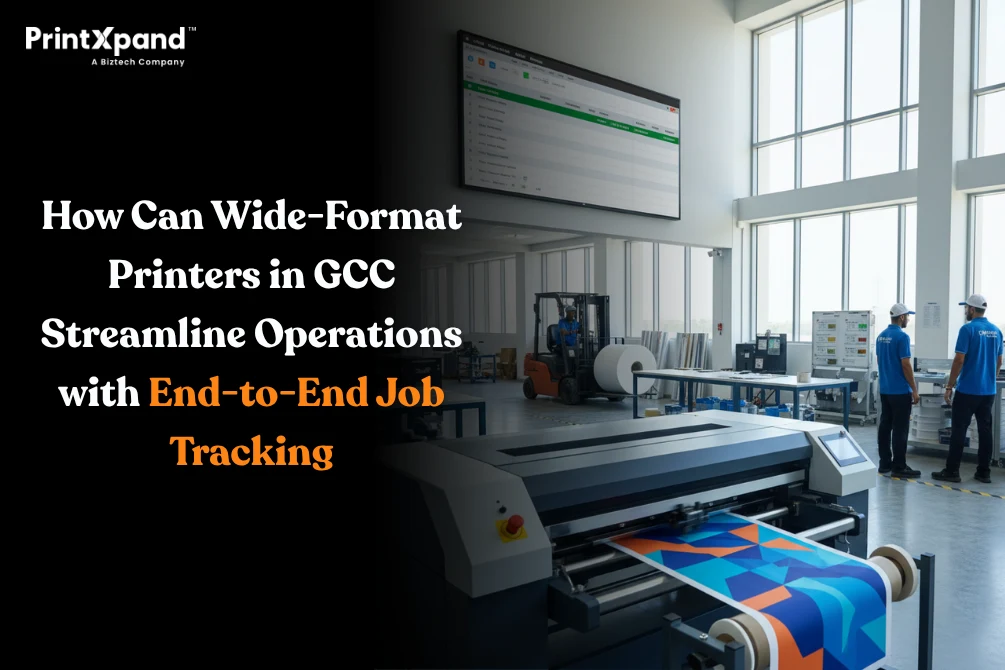
A wide-format print ERP solution that GCC teams can rely on replaces guesswork with shared visibility. Every task moves forward with clear owners, timestamps, and due dates, thanks to automated job ticket printing! An end-to-end job ticketing solution makes sure that no job is missed and the next action is always visible. In short, the solution brings together your sales, prepress, print, and finishing on a single dashboard.
Take the first step toward complete visibility in your print operations.
The PrintXpand ERP Solution for Wide-Format Printers
Most print shops in the GCC already know that manual job tracking does not scale. What they need is a system they can implement to connect every department and manage jobs more efficiently. This is where PrintXpand ERP (the best ERP software for wide format printers 😉) can help. Print Operations can use it to replace scattered tools with a single platform that allows them to share updates, track orders, and make quick, well-informed decisions.
With PrintXpand’s solution, every job can start right from the beginning. The system can automatically create a digital job ticket the moment an order is confirmed. Print shops can set up automated job tickets that capture all key details — from specifications and files to delivery dates. This makes it easier for each team to know what needs to happen next.
Moreover, Print operations can utilize QR-based tracking for prepress, printing, and finishing to maintain visibility of progress. Each scan updates the status instantly, so managers, sales, and production teams see the same information simultaneously. This simple routine helps reduce unnecessary messages and keeps everyone on the same page.
But, the question that arises is, “Can the system handle both urgent one-off jobs and long-term campaigns?” Well, it can! Your teams can configure job priorities, templates, and checkpoints so that quick turnarounds move without blockage, while multi-asset campaigns remain organized and fully traceable.
PrintXpand ERP can also include deadline monitoring that teams can rely on to stay proactive. The platform can flag tasks that risk delay, allowing managers to reassign work or adjust priorities before a schedule slips. Over time, this can lower stress and stabilize capacity planning.
All updates are consolidated into a single end-to-end print job tracking solution. Additionally, managers can view every job, its stage, and its current owner on a centralized dashboard. For shops that prefer a print MIS with job tracking, the solution can complement that setup by providing real-time status and alerts.
At this stage, you may ask, “Does it also integrate with existing MIS or scheduling tools?” Absolutely! You can connect PrintXpand to your current systems, allowing them to retain what works while enhancing visibility and control.
Expert Tip:When implementing ERP-based job tracking, start by standardizing your job naming and file management structure. Use consistent naming conventions for projects, clients, and versions before adding QR checkpoints. This small organizational step helps your team locate files more efficiently, ensures cleaner reporting within the ERP, and prevents confusion when multiple versions of artwork are uploaded for the same job. It is one of the simplest habits that can save hours every week once your wide-format print ERP solution goes live. |
How QR-Based Tracking Improves Accountability
One of the most effective ways for wide-format print shops in the GCC can improve accountability is by using QR-based job tracking. Setting it up doesn’t take much time, but it can completely change how your team stays in sync.
A unique scannable code is assigned to each job ticket once QR tracking is enabled. When prepress, printing, or finishing teams scan it, the update appears right away in the wide-format print ERP solution. Managers, sales representatives, and even clients can check progress without needing to request updates. This single habit can save hours each week and significantly reduce the chances of confusion between departments.
Each scan also confirms that the correct files, specs, and delivery dates are being used. Teams can prevent reprints caused by outdated artwork or missed changes. Over time, this builds a strong culture of responsibility because every handoff is tracked and visible to everyone involved.
As print businesses start seeing results from QR tracking, another question often comes up. Can QR tracking work across multiple production sites? Yes, it can. The system can sync scans from different locations into one dashboard, giving owners full visibility across all branches in the GCC. This makes it easier to manage multi-site operations and monitor job progress without switching between systems.
Print businesses can set up client dashboards for select customers to track job status in real time. Doing this helps clients feel informed and builds lasting relationships with those who bring frequent or high-value projects.
See how QR tracking can bring speed, clarity, and trust to your print operations.
Deadline Monitoring for High-Stakes Wide-Format Jobs
Meeting deadlines is never easy for wide-format print shops in the GCC, especially when several urgent jobs land at once. Using PrintXpand ERP, managers can easily set up a transparent deadline monitoring system. This helps them keep tasks visible and makes it easier to stay on schedule.
Now, whenever a task appears to be at risk of slipping, the system alerts the team so they can address the problem before it becomes an issue. It helps managers keep things balanced. They can see right away which jobs need a push and which are running smoothly.
This proactive setup makes daily scheduling easier, too. It helps managers shuffle urgent jobs without disrupting long projects. That means less chaos near delivery dates and fewer late-night rushes for the team.
As operations grow, one question often comes up: How does the system handle overlapping urgent jobs? It looks at current capacity and suggests quick adjustments so that no priority job falls behind. Another question is just as common: Can managers change deadlines on the fly without breaking the workflow? They can! The system updates schedules in real time, so everyone involved sees the changes instantly.
Expert Tip:If you really want deadline monitoring to work, start noting how long each stage actually takes. Track how much extra time prepress or finishing usually needs on complex jobs. Add a small buffer in your ERP schedule instead of guessing once you have that data. Over time, you’ll start seeing the delays before they even happen – and that’s when your workflow starts feeling truly in control. |
How QR-Based Tracking Improves Accountability
Scaling Job Tracking Across GCC Print Operations
For wide-format print shops in the GCC, the biggest one is keeping its branches coordinated when they start growing. With multiple sites and projects running together, things can fall out of sync faster than expected. A centralized wide format print ERP solution GCC brings everything under one roof—so all your branches operate on a single, connected platform.
With PrintXpand ERP, print businesses can sync work across locations instantly. Every site keeps running as usual, but all their updates flow into one shared dashboard. You can see what each branch is printing, where the team’s ahead, and where a job might be slowing down. In short, the multi-branch web-to-print ERP solution for GCC is an easy way to bring structure to all your branches while still letting them run their own way.
Remote visibility is another major win. If you’re out meeting clients or working remotely, you can still monitor the floor. To view progress, check the job queue, or identify any approaching deadlines, all you have to do is log into the system and quickly glance at the dashboard. Teams update everything from the shop floor, so management can react fast, no matter where they are.
When order volumes spike, the system scales without adding layers of complexity. You can bring in new users, machines, or production lines without throwing off your current setup. That flexibility lets GCC print shops take on bigger contracts and grow with confidence.
A common question from regional businesses: Does the system support Arabic and English for regional teams? Yes. The ERP interface works in both languages, so staff across departments and countries can use it easily.
Another one that comes up often: Can I pull efficiency reports across multiple branches? Yes. The reporting module pulls data from every site into one view, so managers can compare output, turnaround time, and resource use at each location.
Why Wide-Format Printers Need End-to-End Job Tracking
In wide-format printing, missed deadlines and unclear communication do more than slow things down. They cost real money. It’s hard to keep track of every task when workflows are still manual, particularly when multiple teams are in charge of each production stage.
When you implement an end-to-end print job tracking solution like PrintXpand ERP, wide-format printers in the GCC flip that challenge into a competitive edge. Automated job tickets printing keeps every order locked in, QR-based tracking builds accountability at every handoff, and deadline monitoring keeps production moving without delays. These features combine to deliver speed, precision, and full visibility across your operations.
Shops that switch to digital job tracking now are the ones positioning themselves to dominate tomorrow. With tighter communication, reliable delivery, and satisfied clients, they become the go-to partners in a high-speed industry.
Ready to cut out missed deadlines and tighten up your wide-format workflow?