Product Design Tool
How Smart Apparel Print Businesses Are Scaling Personalization with AI + Automation



- Key Takeaways
- Why Is Personalization Crippling Apparel Businesses?
- Let Your Customers Design Their Own Apparel (With Help From Smart AI-enabled Tools)
- Key Features Enabling This Powerful Shift
- Why Ready-Made Apparel Customization Tools Work Better Than Building One From Scratch?
- Use Cases of Custom Apparel Design Software
- You’ve Fixed the Designs; Now It’s Time to Fix the Workflow!
Key Takeaways
- Manual workflows in custom apparel printing are slow, error-prone, and don’t scale. Fixing logos, chasing approvals, and processing customizations manually eat into profit and delay fulfillment.
- Outdated tools and disconnected systems are the real bottlenecks, not customer demand. Most clothing design software fails to support scalable personalization or smooth collaboration between teams and buyers.
- An AI-powered product designer solves this by handing over creative control to customers while ensuring designs are production-ready. Features like real-time previews, artwork checks, and bulk personalization reduce back-and-forth and costly reprints.
- When embedded in a mobile-friendly apparel customization tool, customers can create personalized apparel from anywhere, with instant visual feedback and dynamic pricing that builds confidence and reduces cart abandonment.
- Pre-built integrations with platforms like Shopify and Magento enable teams to launch in days, not months, without relying on developers or patchwork plugins, using proven, ready-to-deploy product customization software for apparel.
- In short, utilizing custom apparel design software powered by AI and automation enables smart apparel businesses to deliver better personalized clothing experiences, streamline operations, and scale profitably.
You’re not in the business of fixing designs. So why is that your daily job?
You started your custom apparel business to print great designs, build a brand customers love, and turn a real profit, not to fix bad logos, retype team rosters, or chase customers for confirmation emails or artwork approvals. But that’s probably what you are doing every day.
Reports say that the global custom printing market is snowballing at a CAGR of 10.3%. By 2030, it is expected to reach its highest point ever, with the clothing segment leading in revenue. But here you are, spending more time managing broken artwork, redoing the designs, and manually processing customizations rather than actually “growing” your business.
What makes it worse is that the systems behind most custom printing operations haven’t evolved either, and they likely won’t anytime soon (at least not without the right custom apparel design software!) In a nutshell, this particular ‘disconnect’ is what is costing you time, profit, and customer trust.
So, regardless of whether you’re a D2C t-shirt brand, a sportswear printer, or a corporate supplier, it’s time to look away from standardized manual systems and start figuring out what’s really going wrong with your apparel personalization process.
Let’s explore why these inefficient processes are breaking hundreds — probably thousands — of businesses like yours. Then, we’ll examine tools for custom apparel printing that utilize AI-assisted creativity and an automation-first approach, eliminating back-and-forth edits and streamlining the process to move orders directly to production without delays or errors.
Why Is Personalization Crippling Apparel Businesses?
Offering personalized apparel used to be a value-add for businesses. But today, it’s a baseline expectation for customers and a ‘boon turned nightmare’ for the businesses, especially if they are doing it manually.
Here are a few examples of what many apparel sellers (including you) are probably dealing with daily:
- Customers upload low-resolution logos that aren’t print-ready. The team spends time fixing them if the issue is caught. If not, it goes into production and later gets returned.
- Bulk orders arrive via messy email threads with names and numbers in no particular order, instead of using structured forms or templates. The production teams end up copying and pasting details and triple-checking for typos.
- Design previews are missing on many websites, prompting customers to email for a visual check. Then come the revisions. Then alternate versions. Suddenly, the print shop is acting like a design agency.
- Many leading eCommerce platforms lack native support for product personalization, forcing sellers to patch together plugins, manual workflows, or custom development that doesn’t scale.
- Customers often upload artwork that is off-center or stretch logos beyond safe zones, resulting in back-and-forth edits that delay production.
- Teams spend significant hours handling individual requests just to fulfill one custom order.
- Businesses are stuck reprinting or refunding orders due to preventable mistakes, such as misaligned text, incorrect fonts, or misplaced logos.
- And worst of all, customers abandon their carts because they can’t see a live preview of what they’re buying. Without visual confidence, they hesitate and leave.
Now, even if you solve those issues for one order, the same cycle repeats with every new customer. This simply results in you losing time, profit margins, and sometimes even the sale itself.
Well, the reality is that this isn’t a technology problem. It’s a workflow problem.
Let Your Customers Design Their Own Apparel (With Help From Smart AI-enabled Tools)
Cutting to the chase, you need to hand over the whole ‘design’ related control to your customers, instead of your internal team handling every little design tweak. Of course, this should be supported by intuitive technology that ensures the results are production-ready.
This way, there would be little to no back-and-forth.
Using tools like AI Product Designer, you can easily make this powerful shift without much hassle, using its:
- Interactive Product Designer
Let customers personalize t-shirts, hoodies, uniforms, and other apparel using an intuitive, on-site tool that requires no external apps or designer support. - Real-Time Design Previews
Customers can see exactly how their product will look before placing an order. Every update, whether it’s a change to the text, artwork, color, or placement, is reflected instantly. - Built-In Artwork Checks
The system automatically flags low-resolution files and keeps content within print-safe zones, reducing your error rate and reprints. However, will giving customers full design freedom lead to production errors? Well, smart personalization tools take care of that by applying hidden guardrails. These checks run in the background to ensure customers enjoy creative freedom, while all outputs remain aligned with print requirements. - Bulk Personalization (Names & Numbers)
With the custom apparel design software, you can enable large teams, schools, or companies to personalize items in bulk using a simple spreadsheet upload option. - AI-Generated Text and Images
Understandably, not everyone is a designer. To make the process easier, the built-in AI technology allows users to generate original quotes, slogans, or images using simple prompts. But beyond creativity, there’s also the question of impact. How do AI-powered design features actually influence order completion? The answer lies in how they remove friction from the buying journey. By generating slogans, images, or clipart instantly from text prompts, AI eliminates the need for external design help. Customers who can see a personalized design preview are significantly more likely to complete checkout, reducing cart abandonment that often happens when buyers hesitate over a blank design screen. - Plug-and-Play eCommerce Integration
It easily integrates with platforms such as Shopify, Magento, WooCommerce, BigCommerce, and others. Additionally, no dev cycles or custom workflows are needed.
In short, it’s apparel product personalization that doesn’t break your backend but gives customers exactly what they want: a better shopping experience that’s personal, interactive, and delightful.
| Expert Tip: | |
|---|---|
| When enabling self-design, make sure the tool automatically restricts logos from being stretched beyond their aspect ratio and keeps all elements within print-safe boundaries. These two checks alone can cut reprint rates by up to 70%. Adding pre-set templates for uniforms, jerseys, or tees gives non-designers a head start and reduces abandoned carts from customers overwhelmed by a blank canvas. | |
Key Features Enabling This Powerful Shift
AI-Powered Features To Enable Creativity
To grow your custom apparel business without overwhelming your team, you need to switch from your basic design tool. What you need is product customization software that solves the real bottlenecks, such as order accuracy, speed, and scalability, without compromising customer experience.
Here’s a list of the essential features your apparel customization tool needs to support this transformation:
Creativity should never feel limited by technical skills. That’s why PrintXpand’s AI-powered tools transform ideas into ready-to-use designs, helping customers bring their vision to life with just a few words or clicks.
AI Image and Text Generation with Prompts
With this, your customers can create artwork and text-based designs just by describing what they want. Instead of uploading logos or browsing through limited clipart libraries, they can type a phrase like “vintage mountain skyline” and instantly see it applied to their product.
This removes creative friction for individuals who know what they want but lack design skills. Put simply, the AI Product Designer helps them move from idea to final design faster, which means fewer support tickets, increased confidence in their order, and a smoother overall buying experience.
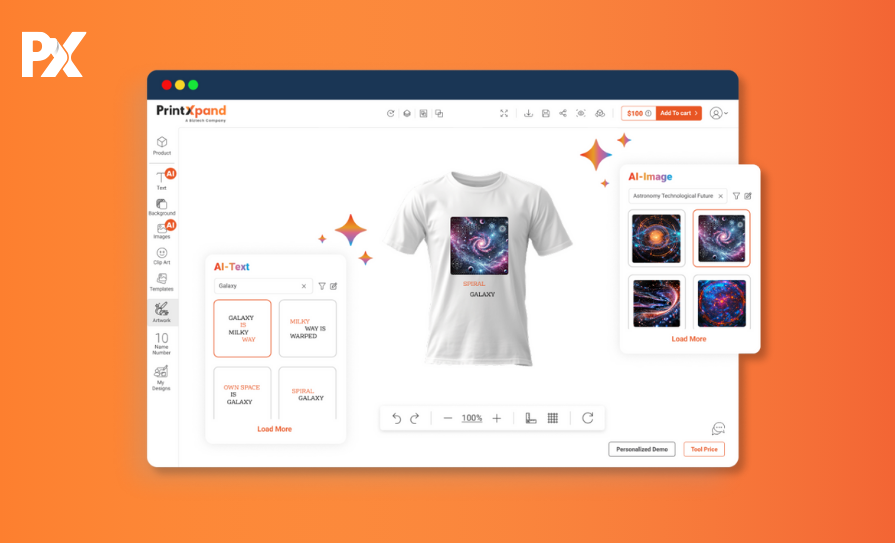
Image showing how AI Image and Text Generate feature works in the custom apparel design software
Automation Features To Streamline Workflows
Once you’ve tackled reseller and catalog management, the next step is making daily operations smoother. That’s precisely where automation features step in.
Bulk Personalization (Name/Number Import)
For businesses handling high-volume team orders, jersey customization, or corporate uniforms, this feature allows automatic personalization of each item using data from a spreadsheet upload.
Instead of manually entering each team member’s name and number into the apparel product personalization tool, the system processes entire rosters in seconds, generating a separate preview for each product. It dramatically reduces manual input, eliminates errors that cause costly reprints, and ensures consistent branding across large orders.
This type of batch processing is essential for sports teams, schools, and enterprise clients. Moreover, with the presence of this feature, you directly leverage higher retention and larger average order sizes.
Video walkthrough demonstrating how the Bulk Name and Number Import (VDP) feature simplifies large-order personalization in the custom apparel design software.
Real-Time Preview
When customers personalize a product by adding text, uploading images, adjusting placement, or changing colors, they see every change reflected instantly on the product preview. The interface displays an accurate, real-time representation of what they are creating, right down to the font style, alignment, and design placement.
This immediate visual feedback removes guesswork from the process. Customers no longer need to ask for mockups or wait for manual confirmations. They know exactly what the final product will look like before placing the order, right on the apparel customization tool screen.
As a result, buyers feel more confident about their purchase, return rates decrease, and the overall shopping experience becomes more engaging and interactive. This clarity at the design stage helps drive more completed checkouts and improves customer satisfaction.
3D Product Preview
Some products, like hoodies, jackets, and all-over print apparel, are challenging to visualize in a flat 2D image. That is why the 3D product preview is such a powerful feature. It allows customers to interact with their customized product in a full 360 degrees by rotating, zooming, and seeing their design applied across every angle.
This realistic, interactive experience helps buyers feel more confident about their purchase. In short, this custom apparel design software feature bridges the gap between imagination and reality. This is especially important for high-value or complex items where design placement and fit really matter.
But does adding advanced features like 3D previews or bulk personalization slow down site performance for larger catalogs? Not at all! Well-designed systems are lightweight and cloud-based, which ensures smooth performance even with extensive catalogs. For example, 3D previews use optimized rendering to load quickly without requiring heavy downloads. Similarly, bulk personalization tools process data server-side, ensuring consistent performance even when handling hundreds of SKUs. Together, these optimizations provide a faster and more reliable experience across devices.
A video demonstrates the transformation of a flat 2D design into a dynamic 3D product preview.
Mobile-Friendly Interface
The entire personalization workflow is optimized for mobile. Whether customers are browsing, uploading designs, entering text on their personalized apparel, or checking out, everything works seamlessly on smartphones and tablets.
This mobile-first design ensures that shoppers can personalize products from anywhere, at any time, without dealing with clunky interfaces or zooming in to click tiny buttons. It supports the modern shopping behavior of customers who expect fast, frictionless experiences on mobile devices, driving stronger engagement and conversions from mobile traffic.
But do customers actually complete the entire personalization workflow on mobile devices, or do they mainly use it for browsing? Increasingly, the answer is that they do complete it, especially in regions where smartphones are the primary means of internet access. A mobile-first interface with large touch targets, drag-and-drop uploads, and real-time previews enables you to design, approve, and check out in a single session. For apparel businesses, optimizing the end-to-end experience on mobile means capturing orders that might otherwise be delayed until desktop access is available.
Video illustrating how product personalization works seamlessly on a mobile device within the design software.
Dynamic Live Pricing
As customers make changes to their personalized apparel, like adding premium clipart, choosing special print methods, or inserting extra lines of text, the pricing adjusts automatically and updates on the screen in real time.
Such transparency helps customers make informed decisions. They see exactly how much each change affects the final price, which builds trust and encourages them to explore more customization options. As a result, businesses see higher average order values and fewer abandoned carts due to surprise charges at checkout.
A video showing how product pricing automatically updates with every design change in real time.
Seamless Integration with Leading eCommerce Platforms
PrintXpand’s apparel product personalization connects directly with platforms like Shopify, Magento, WooCommerce, BigCommerce, Odoo, and others through ready-made plug-ins or APIs. There is no need to rebuild your site or manage disconnected systems.
This type of integration lets you launch advanced customization features within your existing eCommerce setup quickly without any custom development. It ensures a seamless flow from product design to order management and fulfillment.
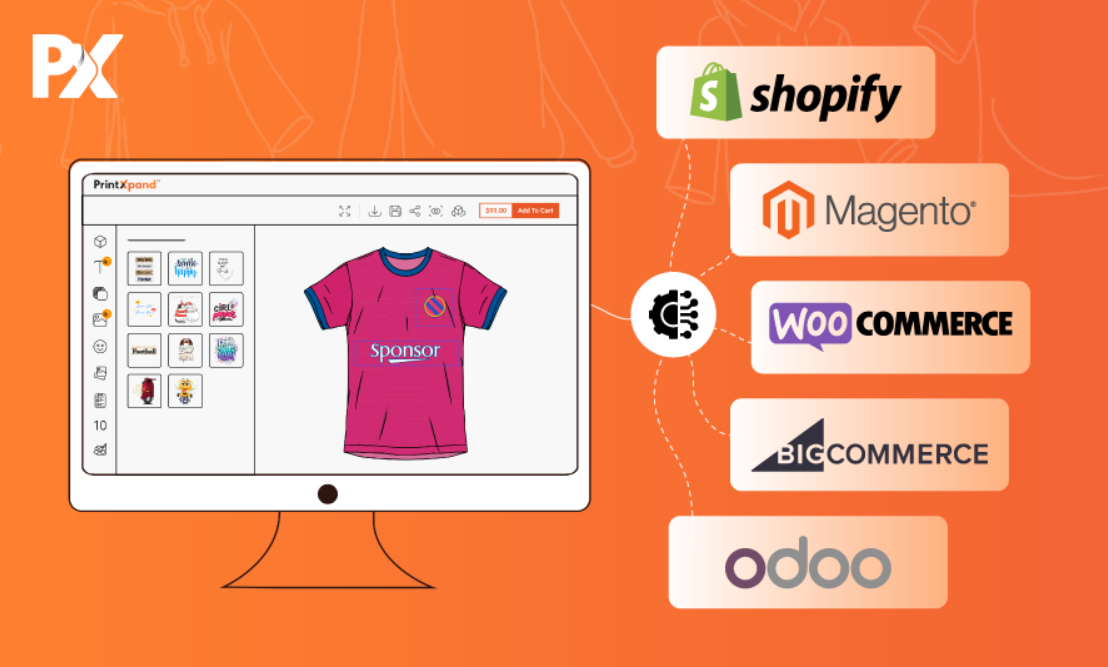
Building a custom solution for personalized apparel can easily consume six months of development time and hundreds of thousands of dollars in costs, with ongoing maintenance overhead that diverts resources from core business growth.
Why Ready-Made Apparel Customization Tools Work Better Than Building One From Scratch?
Scaling product personalization doesn’t mean you have to build everything from scratch. In fact, attempting to do so often leads to lengthy development timelines, spiraling costs, and ongoing maintenance that drains your resources.
A ready-made solution like PrintXpand’s AI-powered Product Designer eliminates all of that. You get access to advanced features like AI-generated designs, live previews, 3D product views, and mobile optimization without writing a single line of code. Most businesses can go live in days, not months.
There’s no complex dev cycle, no debugging phase, and no need for internal tech teams to manage upgrades or integrations. Everything comes pre-tested, pre-integrated, and built with real workflows in mind.
But how do ready-made platforms stay relevant as personalization technology evolves? Solutions like those offered by PrintXpand continuously roll out new capabilities, such as AI-assisted design or 3D previews, without requiring businesses to rebuild their systems. Updates are deployed seamlessly, so apparel businesses always operate with the latest personalization tools while staying focused on sales and fulfillment.
Staying current is one part of the equation, but what about flexibility? Can a business still adapt workflows if the vendor controls the platform roadmap? The answer is yes. Most leading platforms offer robust APIs and modular integrations that enable businesses to extend their functionality or connect with new systems. This ensures flexibility without taking on the burden of maintaining custom infrastructure.
And since updates and new features are rolled out automatically, you always have the latest capabilities without dedicating time or headcount to manage them. Whether it’s a new AI feature or an integration with a major eCommerce platform, it’s ready to use the moment it’s released.
Best of all, you’re not starting from zero. Ready-made solutions are already refined through hundreds of implementations. That means your business benefits from years of proven performance without paying the price for trial and error.
| Expert Tip: | |
|---|---|
| Decision-makers often underestimate the hidden costs of maintaining compliance and security in custom-built platforms. Ready-made solutions distribute these responsibilities across all users, automatically rolling out patches and upgrades. This not only reduces exposure to downtime and vulnerabilities but also frees internal teams to focus on customer-facing innovation rather than infrastructure upkeep. | |
Use Cases of Custom Apparel Design Software
Use Case 1: On-Demand Sports Jersey Store
Whether you’re handling bulk jersey orders, selling custom tees online, or managing corporate uniform accounts, the challenges are the same: slow workflows, constant design revisions, frustrated customers, and no time left to grow your business.
That’s where ready-made clothing design software changes the game.
Here’s how other apparel businesses can solve those exact problems using ready-made product personalization tools without hiring developers or building anything from scratch.
The Challenge:
A growing sports merchandise business manually processes bulk orders for team jerseys. Every name and number is entered manually, which often results in typos, fulfillment delays, and costly reprints. Coaches and team managers feel frustrated, and staff time is maxed out.
The Solution:
By adopting a ready-made product customization tool with bulk name/number import and real-time preview, the businesses can enable team managers to upload a simple CSV file and instantly customize every jersey with zero manual input. This implementation can halve operational workload, reduce errors, and easily accelerate turnarounds to drive repeat business.
The Impact:
- The print team’s operational workload can be cut in half
- Errors can drop by up to 80%
- Faster turnarounds can bring in more repeat orders
- With fewer order issues to manage, the business can expand into new sports categories and markets
Use Case 2: D2C Fashion Startup Selling Statement Tees
The Challenge:
A D2C apparel startup struggles to stand out in a crowded t-shirt market. It relies on generic designs, operates on razor-thin margins, and its eCommerce platform doesn’t support custom apparel printing. Building a custom design tool is financially out of reach.
The Solution:
An AI product designer can be integrated directly into a Shopify store. This allows customers to personalize t-shirts using custom text, AI-generated images, and personal quotes, without requiring design skills or technical support.
The Impact:
- Average order value can increase by up to 30%
- Personalized products can become best sellers
- Cart abandonment can be decreased by engaging live previews
- A new revenue stream can be established with minimal technical overhead
Use Case 3: Corporate Uniform Supplier
The Challenge:
A B2B uniform supplier constantly deals with client-specific design requests, such as custom fonts, exact brand colors, and precise logo placements. Clients often send low-resolution artwork via email, causing production delays, frequent rework, and high return rates. As the business grows, maintaining consistency across orders becomes increasingly tricky.
The Solution:
To fix this, a clothing design software solution can be implemented with built-in artwork validation, design-safe zones for precise logo placements, and a pre-loaded clipart and logo library aligned to brand guidelines (custom fonts and exact brand colors). This setup can enable clients to personalize uniforms directly on the website, preview products in 3D, and approve designs on the spot, eliminating back-and-forth emails and manual corrections while improving consistency across orders.
The Impact:
- Returns caused by artwork issues can drop by up to 70%
- Time-to-market can improve significantly across client orders
- Sales teams can shift focus from managing revisions to onboarding new accounts
- High-margin corporate deals can become easier to close and manage, leading to faster growth across new business segments.
| Expert Tip: | |
|---|---|
|
Apparel businesses that succeed with personalization at scale share a common trait: they standardize their processes before attempting to scale them. The challenges in these use cases, like manual data entry, artwork inconsistencies, and approval delays, are widespread across the industry. What makes a difference is not just adopting technology but adopting the right structure along with it. Ready-made custom apparel design software offers tested, built-in logic that enforces consistency, reduces operational guesswork, and enables teams to spend less time resolving issues and more time fulfilling orders with confidence. |
|
You’ve Fixed the Designs; Now It’s Time to Fix the Workflow!
Custom apparel printing isn’t broken because customers want too much. It’s broken because most businesses are still relying on manual processes, outdated tools, or expensive custom development that never quite delivers.
You don’t need to reinvent your workflow to scale. With the right ‘ready-made’ product customization software, you can simplify the entire process. You can give your customers more control, speed up production, and reduce the day-to-day burden on your team.
In a nutshell, AI helps your customers create without friction. Automation helps your team deliver without bottlenecks. Together, they make personalization possible and make it scalable. And that’s exactly what ready-made tools are built for.
From AI-generated design elements to automation features like bulk personalization, real-time previews, and seamless eCommerce integration, these capabilities enable modern apparel businesses to move faster, sell more, and make fewer mistakes. AI helps your customers create. Automation helps your team deliver faster. Together, they make personalization scalable.
So, if you are ready to streamline your entire custom apparel workflow, you can launch in just 5 days!
Let your customers personalize the way they want, and deliver the kind of experience that keeps them coming back.
All product and company names are trademarks™, registered® or copyright© trademarks of their respective holders. Use of them does not imply any affiliation with or endorsement by them.