



Summary
Everyone loves to start their day with a good, warm cup of coffee or tea. Some people also have their favorite mug for that, the one they will always reach for at the start of their day. You know what can make it even better? Personalized mugs.
What started in the late 90s as a “trend” because transfer painting, as a technique, became famous for designing ceramics, has now taken the form of personalized mugs. From corporate celebrations to curated wedding gifts, these mugs remain among the top gift picks.
This continued rise in demand for mugs makes it a profitable opportunity for print businesses; however, establishing one is not that easy. It requires a comprehensive understanding of all the variables, like investment, revenue generation, and the whole setup in general.
If you also want to know how to kickstart your printing business, then this blog is what you need. We have carefully created this comprehensive guide to help you understand all the variables of the custom mug business from start to finish.
Selling Personalized Mugs: A Profitable Idea That Works
One of the most significant factors contributing to the increase of personalized mugs is the growth of the personalized gift industry. The industry is evolving every day owing to the ever-advancing digital technology.
The global personalized gifts market is expected to reach USD 57.19 billion by 2033 (source). It is also anticipated to grow at a CAGR of 7.5% during the forecast period.
This implies that personalized mug printing can open up many business opportunities for you. Custom-printed mugs can be used as corporate gifts for employees and vendors, as well as for birthdays and weddings.
Further, you can enable your customers to design their mugs by adding logos, taglines, images, etc. This won’t only keep your customers engaged but also contribute to increasing your brand awareness. Adding a product design tool to your storefront that allows customers to add photos, texts, etc., and design the product the way they like it. They can also easily preview the mug after the final design is completed.
And this is precisely what will help your business stand out from the rest. Shoppers will be able to add a personal touch to the gifts, while you will get to enjoy the revenue and engagement.
How to Start a Profitable Mug Printing Business?
A business in mug printing is very profitable, considering the growing demand for personalized items. The steps below are comprehensive enough to help guide a beginner who wants to start a mug printing business.
Step 1. Determine your Niche
No matter what business you want to start, proper planning is the first and foremost requirement. You must understand and define your goals clearly and consider your spending limits. Properly defined goals and a clear budget estimate are the two cornerstones of a well-thought-out plan.
Even the personalized mug market is huge in itself, so rather than going in the general direction, pick up your specialty or your niche. Out of all the options available, like corporate mugs, gifting, fandoms, travel mugs, or eco-friendly mugs, etc., which ones will you provide.
Conduct thorough research, look for trends, on marketplaces and platforms like Etsy to see what is popular among your target market. The key determining criteria should be:
- Audience: If your supply doesn’t match their demands, then it won’t yield fruitful results. Make sure that your supply plan matches what is trending among your target audience. This will ensure an upward-sloping graph for your business.
- Budget & Margin: Obviously, your budget is one of the key determinants in this whole process. Choose a niche that fits your budget and offers sufficient profit margins to invest and save.
Since this one decision will initially carry your business, it is important to fully understand what you are signing up for. So make sure you browse as much as you can, then proceed with your choice.
Another thing is investing in a robust design portal for customers to personalize their mugs. While your other things are variable, we can help you finalize one thing, a robust platform for your customers to engage in a personalized mug process.
Try PrintXpand’s amazing web2print platform and see for yourself how easy it is to facilitate your custom mugs business with the right toolkit.
Step 2. Choose the Right Type of Mug
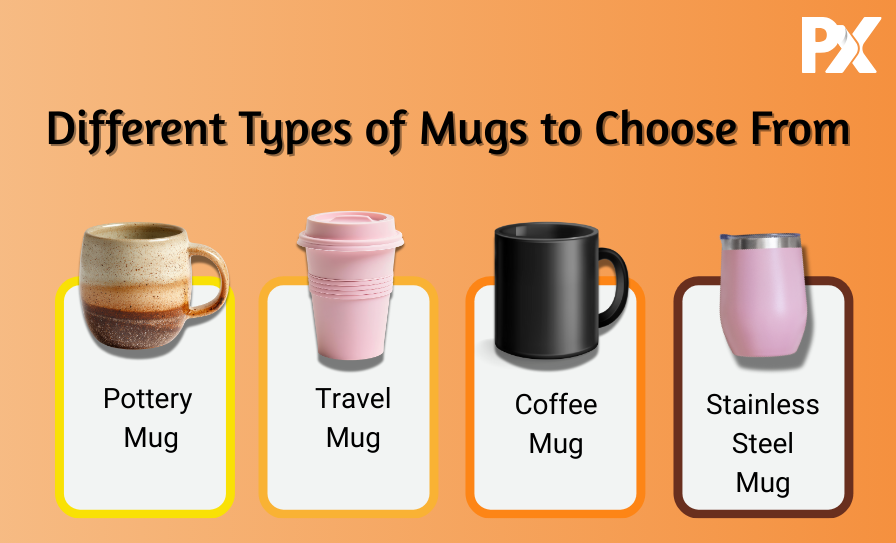
Once you have determined your niche and target audience, it is time to decide which cup variety and printing method you will offer. The key is to determine which varieties best align with your brand image and budget. There are several varieties available in the market to can choose from.
To name some of the popular ones:
- Coffee Mug – A coffee mug is the most prominent and demanded in the entire mug printing industry. You can always sell custom-printed coffee mugs without a second thought.
- Ceramic Mug – Ceramic mugs are resistant to high temperatures and easy to clean. As they retain heat better, they are very suitable for hot beverages like coffee, tea, or even hot chocolate.
- Transparent Mug – Generally made of glass, a transparent mug is highly innovative and suitable for cold beverages like juice, soft drinks, cold coffee, etc. People love designing transparent surfaces.
- Pottery Mug – People who love handmade items often prefer pottery or earthen mugs. They not only look beautiful but are also environmentally friendly because they decompose easily.
- Sport Mug – A sport-themed mug is a great choice for people who love sports.
- Travel Mug – A travel mug is suitable for long-distance travelers, such as hikers who prefer carrying hot or cold beverages.
- Stainless Steel Mug – A stainless steel mug, as the name suggests, is resistant to corrosion and rusting, making it ideal for carrying beverages in humid climates.
- Magic Mugs– As the name suggests, when a hot liquid is poured into the mug, the color changes. This is because they are designed using thermochromic ink, a heat-sensitive paint.
You can pick one, two, or more variants based on our target customers and budget estimates. It will help you compress this vast industry into your use-case-specific options.
Step 3. Select the Right Printing Method
Just like mugs, printing techniques also offer a huge variety for you to choose from, based on your budget, mug material, and capabilities. To name some of the most common ones for you, we have:
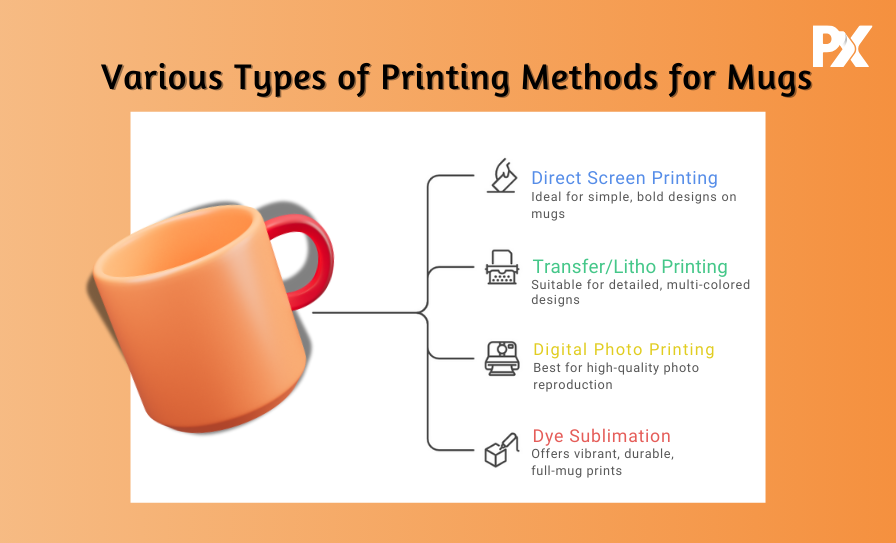
Direct Screen Coffee Mug Printing –
In this method, the ink passes through a screen or mesh. The printer applies a stencil to the stretched mesh. The little holes in the stencil shape the final image on the mug. Ideal for simple designs on earthenware or bone china mugs.
Transfer or Litho Printing Custom Mug Printing
A printer paints an image or design on special paper and then coats the mug with a clear lacquer. Post-coating, the print is transferred onto a water-soluble transfer. This age-old printing method is helpful for printing on ceramic or bone-china mugs.
Digital Photo Mug Printing
A process in which an image or design is printed directly on specially coated paper. It also uses a waterslide transfer to apply the image to the substrate. It is an excellent option for high-quality texts or images.
Dye Sublimation Printing
Dye Sublimation Printing offers crystal-clear images with vibrant colors. It uses organic color dyes and heat transfer to ink the desired artwork on the mug, making the design look brand new for prolonged periods. Best suited for promotional gifts.
All these techniques require different machinery and mechanisms. So invest in your equipment after you have a clear understanding of what material(s) and printing techniques you will use.
Now that you understand what technique and material you will go for, here are some of the brand and design best practices you should follow and implement in your W2P portal for your customers:
- Choose the right tool – Use professional design tools like Adobe Illustrator or Canva Pro for crisp, print-ready artwork. Always generate realistic 3D mockups so customers can visualize their customized mugs before ordering.
- Readability Tips – Maintain high contrast between text and background. Use fonts no smaller than 12pt and avoid overcrowding the print area—white space enhances visual appeal.
- Quality Control: Implement proofing workflows that require customer approval of final designs. Offer sample prints for bulk orders to ensure color accuracy and print durability.
- Branding Consistency: Ensure consistency for products and packaging. Design a cohesive color palette that reflects your brand’s ideology. Extend this identity to packaging such as custom boxes, tissue paper, and thank-you cards to further engage customers and enhance their experience.
A definitive mindset reflects in how you navigate your business and create the experience, not just in an “add to cart” and “purchase” cycle. This is why identifying your choice of material, printing techniques, and brand cohesiveness is important for business growth and sustenance.
Step 4. Build Your Own Online Store
Whether you transition from a traditional printing setup to fully digitalized processes or improve your existing digital presence, it will help you expand your customer base and streamline your workflow. But how to make that shift? Here are some things to help you out with that:
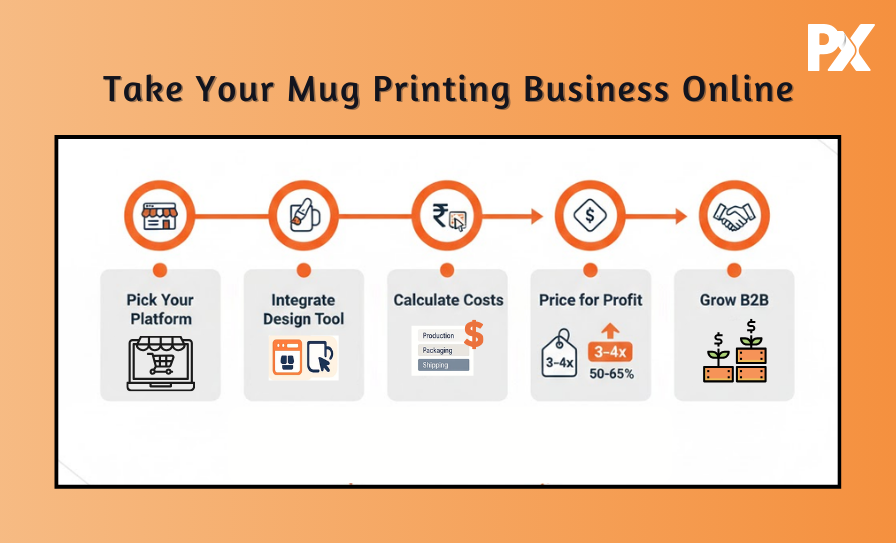
Choose the Right E-Commerce Platform
Your online storefront is the foundation of your digital business, from the UI/UX to the color palette, everything will represent your brand. You can go with popular options like Shopify or WooCommerce, and pair them with a leading product design interface to get your website up and running.
This will help you bring everything together in one cohesive ecosystem, thereby eliminating disconnected systems. From order management to product customization and order fulfillment, you can manage everything in one place with the right platform.
Integrate a Product Design Tool
The heart of any online mug printing business is an intuitive design editor letting customers personalize products themselves. Try to go for a solution with an easy-to-use interface so anyone, from a tech enthusiast to a novice, can use it. Look for features like drag and drop functionality, text editing, images, and real-time 3D previews to elevate customer experience.
Customers should see exactly how their customized mug will look before ordering. This self-service approach reduces communication back-and-forth, minimizes errors, and accelerates processing.
Understand Your Cost Structure
Profitability depends on understanding your numbers clearly. So do a thorough market research to understand trends, cost brackets, and revenue across different business models for you. For instance, blank mugs cost by type: ceramic mugs range from ₹25–50 ($0.50–1.50), and travel mugs cost ₹80–150 ($2–4). Purchasing them in bulk can reduce the cost by 15-30%.
As for printing method, sublimation printing costs around ₹8–15 ($0.15–0.30) per mug, including ink and transfer paper. Heat press equipment requires an initial investment of ₹5,000–50,000 ($200–600) in minimal per-unit costs thereafter. Individual packaging adds ₹10–25 ($0.20–0.50), while domestic shipping averages ₹50–100 ($1–2.50) per unit.
Price for Profit
Standard retail pricing is marked up 3–4x. A ceramic mug that costs ₹50 to produce sells for ₹199–299, yielding 60–75% gross margins. Profit margins vary by model—POD delivers 25–35% margins, bulk printing achieves 50–65%, while B2B wholesale offers 20–30% but compensates through volume. Most businesses break even at 200–500 units monthly.
For bulk production, you can connect your store directly to production workflows. So, when customers place orders, systems will automatically generate print-ready files, assign production queues, and update inventory. This automation eliminates manual entry, reduces errors, and speeds turnaround.
Start with B2C, Scale with B2B Channels
Once direct-to-consumer operations stabilize, expand into B2B. Create dedicated portals for corporate clients with bulk pricing, approval workflows, and invoicing. Partner with event planners and HR departments that regularly need branded merchandise
Step 5. Decide Your Business Model
Now that your niche is decided, investment is calculated, and you have narrowed down your list of raw materials and printing methodology, the next step is to define your business model. In other words, how will you operate?
Some of the popular approaches include:
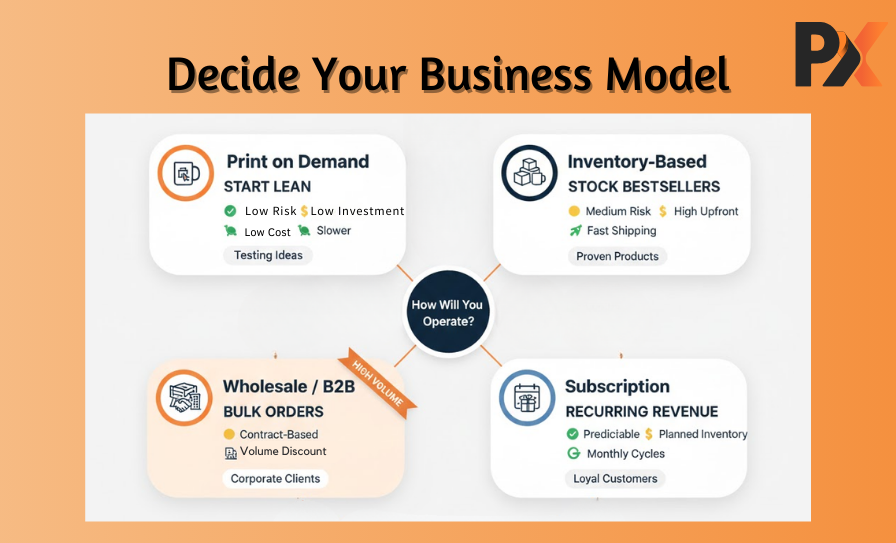
Print on Demand (POD): Start Small, Risk Less
POD is the “make it when they buy it” model. It doesn’t require any massive inventory investment. You print mugs as you receive orders, so nothing is pre-designed or approved. It is perfect if you are just starting your business and test the water first. No warehouse, no bulk inventory.
However, the profit margin in this one is slim, since producing one piece at a time costs more and turnaround is slower, as each order goes through individual production. It is ideal for first-time entrepreneurs, niche designs, and personalized gifts.
Inventory-Based: Stock Bestsellers, Ship Faster
Here, you produce mugs in advance and store them ready to ship. When orders come in, you simply pack and dispatch. This model is for those who know what sells. Bulk production reduces per-unit costs, which increases margins to 50–65%. Customers get faster delivery since products are ready.
However, you’ll need capital for upfront inventory and storage, and you’ll carry the risk of unsold stock gathering dust. This one is perfect for established businesses and proven bestsellers.
Wholesale/B2B: Big Orders, Steady Clients
This is for those who cater to corporate clients, event companies, marketing agencies, or retailers. Because instead of selling single mugs, you take up bulk orders. You get larger orders (hundreds or thousands of units at once), so production becomes more efficient and revenue becomes more predictable.
However, margins are thinner here because bulk orders also entail volume discounts and large investments in infrastructure (both digital management systems and machinery). This is perfect option for those who want to go into corporate gifting, promotional merchandise, branded products for events.
Subscription: Recurring Revenue, Loyal Customers
If you have heard about subscription boxes, seasonal gifts, and themed collections, then you know what this one is about. This model operates on a recurring schedule, with users signing up for monthly/annual subscriptions. It serves as a replenishment service provider for corporate clients.
This approach creates predictable income and builds customer loyalty. Predictability makes inventory management more effortless. But the challenge lies in consistently delivering fresh and exciting products that keeps the engagement going. Ideal business opportunities for this one are gift box services, collector series, corporate supply contracts.
Now, as to which model to go for? There is no right answer, it depends on how you want to grow, your investment capabilities, and risk appetite. Some businesses combine multiple models as they grow and expand, some continue with their initial decisions. So in the end, it depends on what you are comfortable with and how your business evolves as it grows.
Step 6. Market Your Mug Printing Business
Now the final step in your journey is to market your business. Once the online system is established, it is time to acquire customers, or let the potential customers know that your business is now live. Here are some of the marketing channels you can turn to:
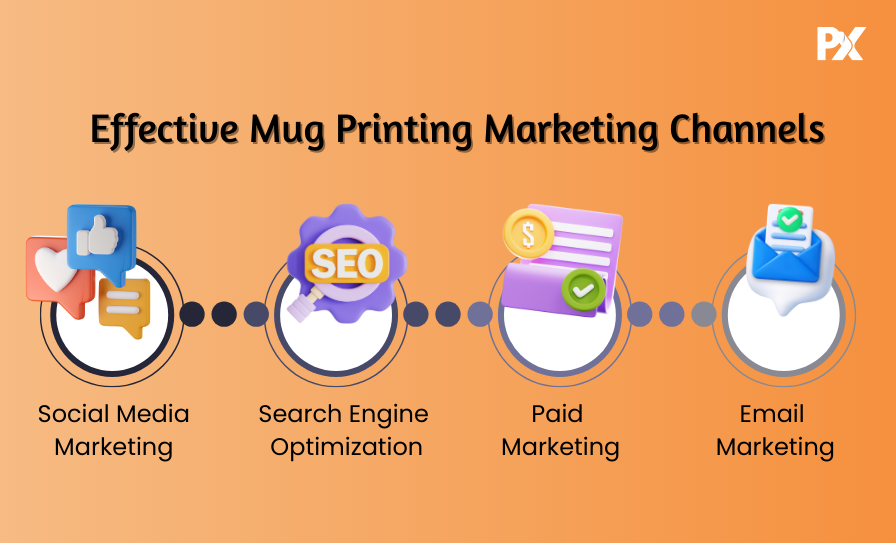
Social Media Marketing
Social media marketing is all about promoting your business on Facebook, Instagram, Twitter, LinkedIn, etc., through your official pages. But which one would be perfect for you depends on who your target audience is,
For example, your mug printing business can attract individual customers looking for artistic mugs or companies looking for corporate custom mugs for gifts to their clients or employees. This makes this business suitable for platforms that have both types of audiences—formal and casual.
In the case of your mug printing business, Instagram and Facebook are better options as you can find both formal and informal audiences, unlike LinkedIn, which is more suitable for only formal audiences. Create social media posts with visually appealing images and videos to increase audience engagement and reach. This will translate into customers. You can create social media posts with eye-catching images and videos using an online video editor like wave. video or Video Editor by Movavi.
Search Engine Optimization
Your website is like your ‘customer representative.’ Without ensuring that your mug printing business shows up in search results, you can’t think of gaining much from your website/store. To show your online presence to a wider audience, you must focus on SEO techniques to rank your site higher.
You can try a combination of SEO techniques and find out which ones work best for you. Some of them include optimizing your site content with proper keywords, ensuring optimal website loading speed, and making it fully responsive across multiple devices.
Paid Marketing
Search engine marketing is always a good option for better long-term results. However, if you have enough funds to invest in paid ads, you can increase awareness about your brand faster and more efficiently.
Email Marketing
Though conventional, email marketing is always a great option for personally connecting individual customers and customizing our products to their preferences and needs.
In emails, surveys like a post-purchase, satisfaction, or post-complaint resolution survey, help engage your customers and know what they think. Accordingly, you can re-strategize your business plans or products, or strengthen your revenue generation strategies.
Ready to Print Your First Custom Mug?
Every successful mug printing business starts the same way—with someone who saw an opportunity and decided to act on it. Perhaps you’ve spotted the gap in your local market for quality custom merchandise. Or you simply want to turn your creative ideas into products people actually buy.
Whatever brought you here, you now have the roadmap. You understand the costs, the margins, and the business models that work. The only piece missing? The right tools to bring it all together.
This is where your journey meets ours.
PrintXpand’s Mug Design Tool lets your customers become creators and design their perfect mug through an intuitive interface while you focus on growing your business. Pair it with a complete web-to-print storefront, and you’re not just selling mugs anymore. You’re running a streamlined operation from design to doorstep.
The mug printing industry isn’t waiting. Your future customers are already searching for someone who can deliver what they’re imagining. Why not make sure they find you?
All product and company names are trademarks™, registered® or copyright© trademarks of their respective holders. Use of them does not imply any affiliation with or endorsement by them.
FAQs
How much does it cost to start a mug printing business?
Starting costs vary by model. Basic equipment, such as a heat press, costs $200–600. Blank ceramic mugs cost $0.50–1.50 each, while sublimation printing adds $0.15–0.30 per mug. Most businesses break even at 200–500 units monthly, which also adds to the cost.
What is the best printing method for mugs?
Dye sublimation printing is the most popular choice for custom mugs. It produces vibrant, long-lasting colors and works well for detailed designs. Other options include screen printing for simple designs, transfer printing for ceramic mugs, and digital photo printing for high-quality images.
Which type of mug sells the most?
Ceramic coffee mugs are the best sellers in the mug printing industry. They’re affordable, retain heat well, and offer excellent print quality. Travel mugs and magic mugs (color-changing) are a close second for their novelty appeal and practicality.
What is the difference between POD and bulk mug printing?
Print-on-demand (POD) means you print mugs only after receiving orders, requiring no inventory but offering lower margins (25–35%). Bulk printing involves producing mugs in advance, requiring upfront investment but delivering higher margins (50–65%) and faster shipping.
Do I need a website to sell custom mugs?
While not mandatory, having an online store significantly expands your reach. Platforms like Shopify or WooCommerce, paired with a product design tool, let customers personalize mugs themselves, reducing manual work and attracting customers beyond your local area.
What equipment do I need for mug printing?
Essential equipment includes a heat press machine for sublimation printing, a computer with design software, a sublimation printer, transfer paper, and blank mugs. Additional items include packaging materials and quality control tools for checking print accuracy.
How do I market my mug printing business?
Focus on Instagram and Facebook for visual content showcasing your designs. Optimize your website for SEO using relevant keywords. Email marketing helps retain customers, while paid ads can accelerate brand awareness. Partnering with corporate clients for bulk orders also drives steady revenue.
Can you make money with print-on-demand mugs?
Certainly, it is possible to profit from print-on-demand mugs by creating one-of-a-kind, attractive designs, promoting them effectively, and using platforms like Etsy or Shopify to reach customers. Creating designs that connect with your target audience and continually advertising your products is essential to boost sales.