Print ERP
How Saudi-Based Commercial Printers Should Streamline Print Estimations to Close Deals Faster




Imagine a scenario in which a typical print vendor in Riyadh receives an urgent request for a quote for 5,000 brochures, including lamination and spot UV. The sales team can churn the data with Excel sheets and skim through supplier rates. It is up to the specialized skills to manually calculate material and finishing costs. The quote gets ready in a few hours to a couple of days. But by then, the client may have already chosen another printer who replied within fewer hours.
This story is common across commercial printing companies in Saudi Arabia. Manual print estimations can slow down your business nowadays. And pricing could be extremely inconsistent as after all, it is a person-driven formula. When estimates are delayed, clients lose confidence, and the opportunity can slip away. In a market where speed and precision decide who wins the deal, guesswork has no place.
Print estimation doesn’t need to be this stressful. With the help of a print estimation tool, Saudi Commercial Printers should, in fact, focus on generating instant, accurate quotes. Modern CPQ for commercial printers, integrated with a Web-to-Print ERP in Saudi Arabia, can bring all cost elements — materials, labor, and finishing — into a single automated system. The result is faster quotes, fewer mistakes, and greater client trust.
Why Manual Estimation Hurts Commercial Printers
Manual print estimation might seem manageable at first, but it can quietly slow down every part of the sales process. Manual print estimation might seem manageable at first, but it can quietly slow down every part of the sales process. Valuable time that could be used to close new deals is instead lost to manual work that rarely delivers consistent results.
Every extra hour spent estimating can mean a delayed response to clients. In the competitive commercial printing market of Saudi Arabia, those delays can easily cost a potential contract. It helps to ask one simple question: how much revenue is being lost due to delayed quotes? The truth is that every missed RFQ or late response directly reduces monthly sales. When competitors reply within the same day, they capture deals that could have been yours. Over time, even minor delays can amount to hundreds of thousands of riyals in lost opportunities.
Manual calculations can also increase the chances of mistakes. And that mainly happens when you’re dealing with complex jobs that involve multiple substrates and exceptional finishes. Each error not only leads to rework but also damages credibility. When clients notice price corrections after a quote has been sent, confidence can drop instantly. So, what percentage of estimates usually need corrections after submission? In most print shops that rely on spreadsheets, you can see almost one-fourth of quotes revised later because of missed finishing costs or miscalculated quantities. That’s a clear signal that the process needs improvement.
Expert Tip:Measure how long it takes your team to deliver an average quote. If it’s more than 24 hours, automation through a modern print ERP system can reduce that time by nearly 70%, helping commercial printers in Saudi Arabia improve both accuracy and client satisfaction. |
The PrintXpand ERP Advantage for Estimation
There are several moving components in every print job, from choosing the right paper and ink type to binding and finishing. Managing all of them manually can result in missed details and inconsistent pricing. But with PrintXpand ERP, you can centralize all specifications, cost components, and workflows in a single platform. Having all the required job data in one place ensures that your sales, production, and finance teams can continue to work with the same information. Such consistency, in turn, not only reduces confusion but also eliminates repetitive data entry.
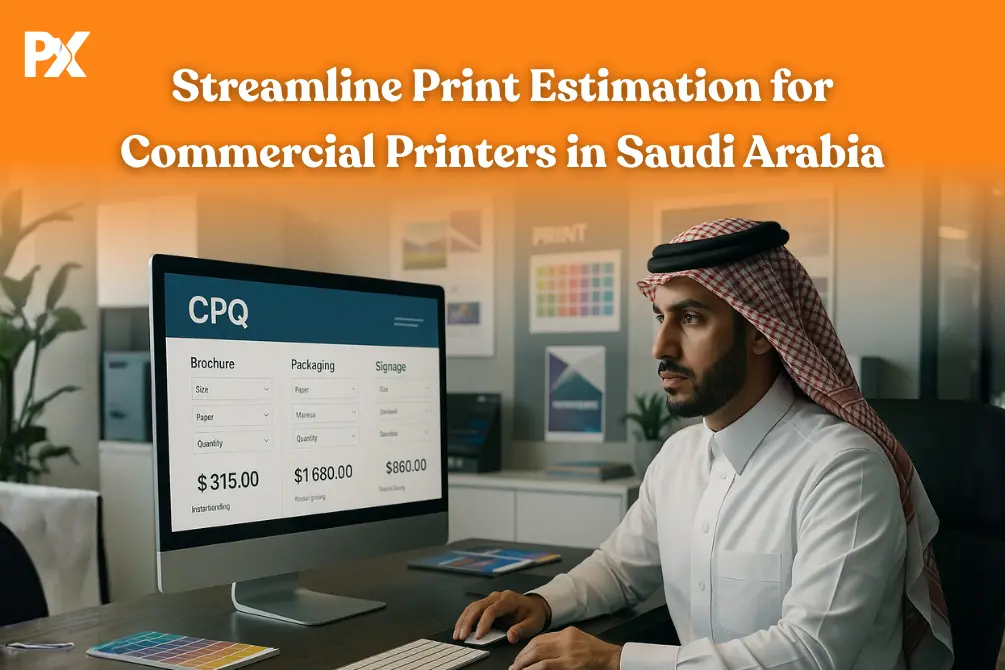
The real power of PrintXpand’s ERP lies in its Dynamic Price Calculator (CPQ for commercial printers). This advanced print estimation tool can automatically calculate quotes based on materials, print quantities, finishes, and labor inputs. Each time a user enters a specification, the system can instantly update the cost, creating fast, accurate estimates. Whether the request is for business cards, catalogs, or signage, the pricing stays consistent and transparent.
Another powerful feature is the Product Configurator. It can guide sales teams or clients through the correct product dependencies. For example, if a customer selects lamination, the system automatically shows only paper types compatible with that finish. This prevents invalid combinations and saves teams from costly errors during estimation.
PrintXpand’s ERP solution also offers Variant Handling, allowing you to create multiple versions of a quote with just a few clicks. With this feature, a salesperson can quickly walk clients through the price difference — say, between 2,000 and 5,000 units or between matte and gloss. Seeing the options side by side makes the decision much easier. And that speeds up decision-making and encourages upselling.
When businesses evaluate such automation tools, they may ask, “Can the CPQ handle both offset and digital printing estimates?” Well, with PrintXpand’s solution, the answer is yes. You can use the system for both offset and digital jobs, as it adapts to each by accounting for run lengths, setup times, and machine costs.
Another question often asked is, “How flexible is the configurator for unique client requirements?” PrintXpand’s configurator is designed for customization, allowing administrators to add new materials, finishes, or rules as business needs evolve.
See how automated estimation saves hours per quote!
How the CPQ Advantage Helps Commercial Printers Get Faster Quotes and Close More Deals
In the commercial printing industry, timing often decides who wins the deal. Clients usually compare two or three vendors, and most award the job to the vendor who responds first with a clear, accurate quote. This makes speed a true competitive edge. A printer who delivers estimates within hours naturally appears more reliable and professional than one who takes days.
Quick responses also build confidence. And when customers receive transparent quotes, they know exactly what they are getting. That builds greater trust, less back-and-forth, and fewer obstacles to negotiation. Eventually, these minor enhancements result in a reputation for reliability, which is what every printing business in Saudi Arabia aims for.
So, how much faster can an automated CPQ generate bulk job quotes? The difference is vast. What used to take several hours of manual calculations can now be completed in minutes. A print estimating software for commercial printers can generate multiple quotes at once — for example, different paper sizes, finishes, or quantities — without requiring separate manual entries. This gives sales teams more time to follow up with clients instead of working through spreadsheets.
Many print business owners also ask, “Do faster quotes directly translate to higher deal closures?” Yes, they do. B2B sales environments consistently show that the first vendor to respond has a 50% higher chance of closing the deal. In commercial printing, where RFQs often have tight deadlines, that speed can make all the difference.
Expert Tip:When your team starts responding faster, make sure their quotes stay consistent, too. Train everyone to follow the same pricing method for every RFQ, whether it comes from sales, customer support, or your online portal. With automation keeping things uniform, clients begin to see your business as reliable and professional from the very first interaction. |
Improving Accuracy with Dynamic Pricing
Accuracy in print estimation is about speed and keeping quotes in sync with real-world costs. PrintXpand solution’s dynamic pricing feature can ensure that every estimate reflects the most recent material, labor, and market price updates. When suppliers change rates or production costs shift, the system automatically adjusts calculations to stay current.
This real-time costing can help avoid underquoting or overpricing. Manual updates often miss hidden cost fluctuations, which can quietly reduce profit margins. With a print estimation tool in Saudi Arabia that dynamically updates pricing, every quote becomes both accurate and competitive — even in fast-changing market conditions.
Many printer business owners often wonder, “Does the calculator update itself when material prices go up or down?” It does. The CPQ connects with supplier lists or your own cost tables, so every new quote includes the most recent numbers.
Another question that usually comes up is, can different margins be set for B2B and B2C customers? They can. The system lets you adjust profit margins based on who you are selling to. It can also make tweaks based on the order size and the frequency with which the client buys. This flexibility helps printing businesses keep prices fair while still protecting profits.
Configurator-Driven Ordering Experience
Modern print buyers expect faster quotes, along with complete control and clarity while configuring the orders. And the Product Configurator built with PrintXpand’s solution can offer exactly that!
It can guide users through every step and help them choose paper types, finishes, quantities, along packaging options. Such guided selection ensures that customers don’t feel overwhelmed seeing the technical details and make confident decisions about their print jobs.
The configurator can also maintain accuracy in the background by limiting the number of possible combinations. For example, it won’t allow spot UV on unlaminated paper or metallic ink on incompatible substrates. This built-in error prevention can save both the sales team and production staff from costly reworks and misunderstandings.
So, can clients configure jobs themselves online? Yes. Through the connected Web-to-Print ERP in Saudi Arabia, clients can access the configurator directly on your website, explore print options, and see updated prices instantly. The self-service model simply saves your team time and improves the customer experience by offering instant clarity and transparency.
Another common question is, how do dependency rules prevent incorrect orders? Dependency rules act as smart guards in the system. They can automatically filter out invalid combinations, ensuring that only feasible production options are displayed. This way, clients never order something your press can’t produce, keeping operations smooth and error-free.
Deliver smarter client experiences with guided product configurators!
Scaling Estimation Across Saudi Print Enterprises
As commercial print businesses grow, maintaining consistent pricing across branches becomes a challenge. Different teams often use different cost sheets, which leads to confusion and uneven quotes. With a print ERP solution built for Saudi Arabian businesses, that problem can be solved! The system can centralize everything from pricing rules to job templates and cost parameters so that every branch follows the same structure. So, whether the quote comes from Riyadh, Jeddah, or Dammam, it’s calculated using the same logic (and real-time cost data too!)
Integration with ERP can make scaling even easier. Your sales, production, and finance departments can work together through shared data. In short, information flows smoothly between departments. Such alignment keeps your operations efficient while reducing delays in estimations, job approval, and production. It can also strengthen regional competitiveness by helping printers deliver accurate, fast quotes—something clients now expect from leading print enterprises in Saudi Arabia.
Printers often ask, “Can the CPQ scale to handle offset, digital, and large-format printing together?” Yes, it can. PrintXpand’s CPQ supports all major print technologies with customizable workflows for each.
Another question that may arise is, how easy is it to roll this out across multiple branches? The system’s modular setup can allow gradual implementation—starting with one site and expanding as teams get comfortable.
Expert Tip:Begin by automating your most frequent print categories in the CPQ system, such as brochures, flyers, or packaging. Once your team gets used to the workflow, gradually introduce specialty or custom jobs. This step-by-step rollout ensures stability and faster adoption across branches. |
The Future of Print Estimation in Saudi Arabia
Manual quoting is quickly becoming outdated. It slows down responses, increases errors, and often results in missed deals. On the other hand, when estimation is automated through ERP and CPQ systems, the way a print shop works starts to change. It links sales, production, and finance into a single, simple workflow. Thus, cutting down on time helps you build trust with clients.
The outcome is clear: faster quotes, accurate pricing, and a more confident buying experience. Print businesses that embrace automation are already seeing stronger client relationships and higher RFQ win rates. As Saudi Arabia’s printing industry continues to modernize, the future belongs to those who digitize their estimation workflows.
So, are you ready to simplify estimation and win more deals?